


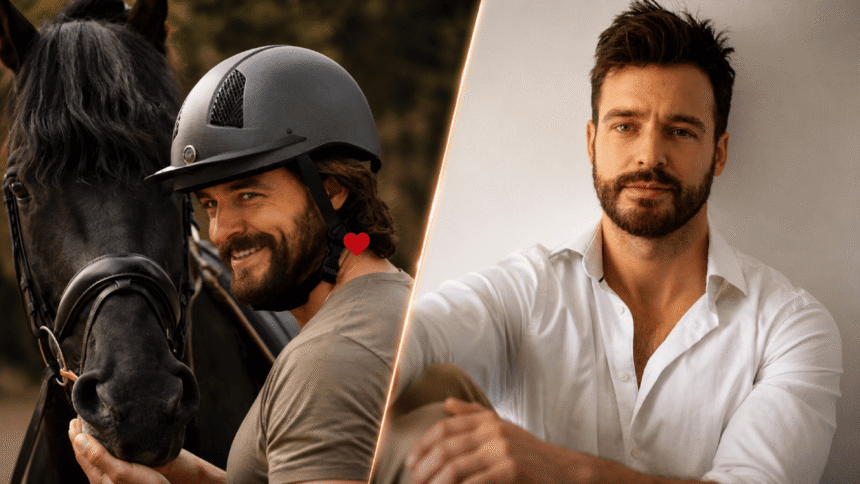
Jake Stormoen is best known for playing the charming half-elf Dagen in the Mythica films and Captain Garret Spears in The Outpost. Those roles place him firmly within modern fantasy television and cinema, but his career has been shaped as much by geography as genre.
Born in Minnesota, educated in Australia and initially based in Los Angeles, Stormoen found his most productive professional community in Utah. He later travelled to Serbia for The Outpost, a series whose imagined frontier depended heavily on real landscapes, constructed settlements and international production crews.
His route offers an alternative to the standard Hollywood success story. Rather than waiting for one major studio role, Stormoen developed within a connected independent filmmaking network—returning to the same collaborators, learning different production jobs and eventually moving from actor to director.
From Minnesota to Australia
Stormoen was born in Minneapolis and grew up with an enthusiasm for fantasy, games and imaginative storytelling. Instead of immediately attending an American drama school, he travelled to Queensland to study creative media at the University of Southern Queensland.
Toowoomba, where the university is based, is far removed from both Minneapolis and Hollywood. That distance appears important in retrospect. Studying creative media gave Stormoen an education that extended beyond acting and into the mechanics of production.
Actors are often discussed as though they arrive after a film has already been designed. In reality, performance is shaped by camera placement, editing, sound, schedules and the practical limits of a location. Training behind the camera can help an actor understand why a scene must be adjusted rather than treating each production decision as an obstacle.
After completing his studies, Stormoen returned to the United States and moved to Los Angeles. Like many actors at the beginning of their careers, he balanced auditions and classes with other employment.
The decisive opportunity did not come from remaining inside Los Angeles. It came through travelling repeatedly to Utah.
Utah’s Independent Fantasy Network
Stormoen’s association with Utah-based Arrowstorm Entertainment became the foundation of his career. The production company developed a recognisable catalogue of fantasy and science-fiction projects on budgets far below those of major studio franchises.
Utah is particularly suited to this kind of filmmaking. Its mountains, forests, desert formations and open terrain can represent multiple imagined worlds without requiring extensive travel between countries.
The state’s appeal is not simply visual. Independent fantasy depends on logistical concentration. Costumes, weapons, creature effects, stunt performers and location access must be coordinated without the financial safety net available to a large studio production.
A reliable local network therefore becomes as valuable as a dramatic landscape. Filmmakers who know the available locations, crews and practical resources can place more of the budget on screen.
Stormoen became part of that ecosystem rather than appearing for a single production and leaving. One job led to another, allowing professional relationships to accumulate across several projects.
That continuity explains more about his career than the idea of a sudden breakthrough.
Dagen and the World of Mythica
Stormoen’s defining early role was Dagen in Mythica: A Quest for Heroes. The film introduced a group of adventurers led by Marek, an aspiring magician played by Melanie Stone.
Dagen is a half-elf rogue whose quick humour and self-interest disguise deeper loyalty. He belongs to the fantasy tradition of the charming thief: useful in dangerous situations, difficult to trust and usually ready with a remark when the group’s more serious members become overwhelmed by destiny.
Stormoen returned across the original five-film arc, which also included The Darkspore, The Necromancer, The Iron Crown and The Godslayer.
The series developed through a production model closer to tabletop role-playing than blockbuster world-building. Its strength came from the recurring party of characters, practical locations and the sense that each film represented another campaign undertaken by the same group.
That structure rewarded cast chemistry. Audiences did not need every kingdom or magical system to possess the detail of a major franchise. They needed to believe that these adventurers had travelled, argued and survived together.
Stormoen’s Dagen helped create that continuity. His humour prevented the mythology from becoming self-important, while his loyalty gave the group an emotional bond beneath its constant danger.
The original Mythica project was also partly supported through crowdfunding. That detail places the series within a period when independent filmmakers were learning to build productions with direct audience participation rather than relying exclusively on conventional studio finance.
Why Small Fantasy Productions Matter
Independent fantasy is frequently judged against films with budgets hundreds of times larger. That comparison misses what smaller productions actually contribute.
They provide a testing ground for performers, directors, costume designers, stunt teams and effects artists who need experience working within the genre. Fantasy requires specialised visual and physical storytelling that cannot be learned entirely in a classroom.
A performer must understand how to use a prop weapon safely, respond to effects that may be added later and deliver unfamiliar terminology as though it belongs to ordinary life. The actor must also maintain conviction when the set is smaller and the imagined world is less physically complete.
Stormoen’s career demonstrates the value of that environment. Repeated work within fantasy allowed him to develop genre fluency. He does not approach an invented world with embarrassment or attempt to distance himself from its conventions.
That sincerity matters. Fantasy fails quickly when performers behave as though they are more sophisticated than the material.
Garret Spears and The Outpost
Stormoen reached a broader television audience as Captain Garret Spears in The Outpost, which ran from 2018 to 2021.
The series follows Talon, played by Jessica Green, after she travels to a remote fortress while pursuing the people responsible for destroying her village. Garret begins as a disciplined military figure but becomes central to the show’s political conflicts and relationships.
Compared with Dagen, Garret required Stormoen to work with greater restraint. Dagen could deflect danger through wit; Garret carried responsibility for other people and often had to communicate pressure without openly expressing it.
The role also tested his ability to sustain a character across several seasons. A film performance has a completed arc, but television characters develop in response to audience reception, production changes and stories that may not have been planned when the actor was first cast.
Stormoen appeared throughout much of the series and also directed an episode during its fourth season. That move behind the camera was not a random expansion of his résumé. It followed naturally from his creative-media education and years of observing how fantasy productions are assembled.
Serbia as a Fantasy Landscape
Although The Outpost was created for an American network, significant production took place in Serbia. The country’s landscapes, historic architecture and established crews have made it an increasingly useful destination for international film and television.
For viewers, Serbia disappears into the fictional world. Stone structures, wooded hills and purpose-built sets become locations on the edge of an imaginary civilisation.
That transformation is one of screen travel’s central pleasures. A place can carry two identities at once: the geography experienced by residents and visitors, and the fictional geography created through framing, costumes and production design.
Fans searching for The Outpost locations should approach them with that distinction in mind. A camera may connect sites that are geographically separate, while editing can make a small exterior appear attached to a much larger invented fortress.
The production does not provide a literal map of its fictional world. It provides a collection of visual impressions assembled from real terrain.
Stormoen’s work connects those spaces. His performances in Utah and Serbia belong to different productions, yet both demonstrate how landscapes outside Hollywood supply much of the physical texture associated with contemporary fantasy.
Returning to Mythica as a Director
Stormoen later directed Mythica: Stormbound, the sixth instalment in the series. Moving behind the camera changed his relationship with the franchise.
As Dagen, his responsibility had been concentrated within one character. As director, he had to consider the entire production: visual continuity, performances, pace, coverage and how the new story would relate to the established Mythica world.
Directing a continuation can be harder than beginning an unrelated project. Existing fans carry expectations, while budget and scheduling constraints remain real. The director must preserve enough of the earlier identity for the film to feel connected without simply repeating what the series has already done.
Stormoen brought an unusual advantage. He understood Mythica from inside its original ensemble. He knew how its tone balanced sincerity, humour and adventure because he had helped perform that balance across five films.
The shift also reveals a broader principle of sustainable independent filmmaking: people who learn more than one role become increasingly valuable. A performer who understands editing, production and direction can continue contributing even when a particular character’s story has ended.
Voice Work, Gaming and Fantasy Credibility
Stormoen’s connection to fantasy extends beyond live-action performance. He has contributed voice work to The Elder Scrolls Online and has spoken openly about his interest in gaming and tabletop culture.
He also developed fantasy-themed dice and jewellery projects, placing him within the fan culture surrounding the genre rather than treating it only as professional employment.
His long friendship with Game of Thrones actor Kristian Nairn reportedly began through playing World of Warcraft online. The two later appeared together in the horror film The Appearance.
That progression—from online gaming friends to screen collaborators—captures how fantasy communities operate across borders. Players can form meaningful creative relationships before meeting physically, then carry those relationships into conventions, productions and businesses.
For travellers, gaming and fantasy conventions increasingly function as destinations in their own right. Fans travel for shared participation rather than passive sightseeing, temporarily turning exhibition centres and city venues into communities organised around fictional worlds.
Stormoen’s presence within that culture gives his performances credibility. He understands why these worlds matter to the people watching them.
Romance Films and Work Beyond the Sword
Although fantasy defines much of Stormoen’s public profile, he has also appeared in romantic and seasonal television films, including Christmas Wonderland, Love, Lost & Found and Quest for Love.
These productions require a different performance rhythm. Fantasy externalises conflict through battles, magic and political threats; romance places greater emphasis on conversation, chemistry and emotional accessibility.
The settings also work differently. A fantasy landscape is meant to feel distant from ordinary life, while a romantic television film often turns a recognisable small town, holiday destination or scenic retreat into an inviting emotional space.
Working across both forms prevents Stormoen from becoming entirely dependent on armour and invented kingdoms. It also reveals the practical versatility required of a working actor whose career develops through independent and television production rather than one dominant franchise.
A Career Built Through Return Journeys
The non-obvious feature of Jake Stormoen’s career is repetition—not the repetition of playing identical characters, but the decision to return to productive places and collaborators.
Los Angeles offered access to the industry, but Utah gave him a filmmaking community. Mythica provided a recurring role, then eventually an opportunity to direct. The Outpost took him to Serbia and expanded his work from performance into episodic direction.
That pattern differs from the popular image of an actor advancing through a sequence of ever-larger auditions. Stormoen’s progress came through accumulated trust. Each completed production made the next collaboration easier because the filmmakers already understood how he worked.
For audiences, his projects offer a guide to the less visible geography of fantasy filmmaking. Epic-looking worlds are not produced only on enormous sound stages. They can emerge from Utah valleys, Serbian fortresses, regional crews and teams willing to build several films together.
Jake Stormoen’s career shows what happens when an actor does more than pass through those worlds. He learns how they are made—and eventually takes responsibility for creating one himself.
For more interesting one Read like on How Old Is Everleigh LaBrant? Her Age and Life in the Public Eye.