


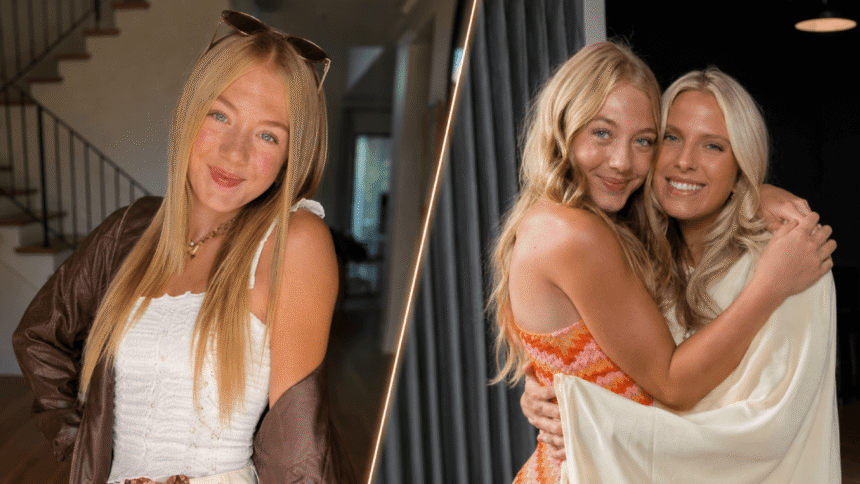
How old is Everleigh LaBrant? She is 13 years old as of August 2026. Born on 14 December 2012, she will turn 14 on 14 December 2026.
Yet the interest surrounding Everleigh LaBrant age reflects something more complicated than a birthday calculation. She has appeared online since early childhood, meaning millions of viewers have watched her grow up through family videos, dance performances and social media posts.
For followers, those appearances can create a sense of familiarity. For Everleigh, they form a public record of childhood that she did not initially have the maturity to understand or control. Her story therefore sits at the centre of a question confronting parents, platforms and audiences: what happens when growing up becomes publishable content?
Why Everleigh Became a Familiar Face
Everleigh is the eldest daughter of Savannah LaBrant and the late Tommy Smith. Savannah later married content creator Cole LaBrant, with whom she built The LaBrant Fam’s large online following.
The family’s videos combine parenting, celebrations, challenges and major life events. Everleigh became one of its most recognisable members, particularly through dance-related content and videos centred on birthdays, surprises and family milestones.
This matters when explaining why readers regularly ask how old she is. Most young performers become visible through discrete projects: a film, television series or stage production. Family influencers appear in an ongoing narrative. There may be no clear boundary between the child’s performance and ordinary life because both can become material for the same channel.
A conventional child actor leaves the set. A child appearing in family content may effectively live on it.
That distinction is easy to miss when each upload looks cheerful and self-contained. Viewed collectively, however, the posts can document years of physical, emotional and family development. The audience is not merely watching a young entertainer’s work; it is watching a person age.
Getting the Age Calculation Right
Online biographies frequently become outdated because they present an age as though it were a permanent fact. A birth date is stable; an age is not.
Everleigh was born on 14 December 2012. The calculation therefore depends on whether her birthday has occurred in the current calendar year:
- She turned 13 on 14 December 2025.
- She remains 13 until 13 December 2026.
- She turns 14 on 14 December 2026.
This date-based approach is more reliable than copying an age from an undated celebrity profile. Recent reporting also identified Everleigh as 13, while older articles naturally described her as 11 or 12. Those reports are not necessarily contradictory; they were published at different points in her life.
Her surname can create similar confusion. Everleigh was previously widely known as Everleigh Rose Soutas or Everleigh Rose Smith-Soutas. After Cole LaBrant adopted her, she publicly referred to being called Everleigh LaBrant. People’s report on the adoption anniversary provides useful context for that change.
A Childhood Measured in Uploads
For most people, childhood photographs are stored in family albums or private phone galleries. Everleigh’s milestones have often been distributed to an audience.
That creates an unusual form of public chronology. Viewers may remember her at four, eight or ten because a birthday video from that year remains searchable. Earlier versions of her do not disappear as she grows older; they continue accumulating views alongside newer content.
The non-obvious consequence is that age becomes part of the entertainment format. A birthday does more than mark another year. It can produce a title, thumbnail, storyline and spike in audience interest. The platform turns time itself into content.
This does not prove that every family video is harmful or that a child cannot enjoy participating. It does mean that the adults making publication decisions hold considerable power. A young person may agree to be filmed without understanding how searchable, reproducible and persistent the resulting material could become.
Consent at 13 also cannot retroactively resolve every decision made at three or six. As children mature, they may develop different views about which moments should remain public.
Why Responsibility Cannot Rest on the Child
Discussions about young influencers sometimes ask whether the child “likes making videos”. That is relevant, but it is not enough.
Children can genuinely enjoy performing while still needing adults to protect their privacy, earnings and future choices. Enjoyment does not eliminate the imbalance between a minor, a parent controlling the account and a platform benefiting from engagement.
The more useful questions concern the structure surrounding participation:
- Can the child decline an appearance without pressure?
- Are earnings attributable to the child protected for their benefit?
- Are embarrassing, medical or emotionally vulnerable moments kept private?
- Can older content be removed if the child later objects?
- Are education and offline development protected from production demands?
These safeguards matter more than trying to diagnose a family through edited clips. Viewers see the published material, not the discussions and decisions that happened before the camera was switched on.
Cole and Savannah LaBrant have said that their children participate willingly and are compensated. Those claims belong to the family’s account of its practices. They do not remove the wider need for enforceable protections across the influencer industry, where standards cannot depend entirely on each parent’s judgement.
The Law Is Beginning to Catch Up
Child performers in established entertainment industries are generally covered by rules concerning working conditions, education and protected earnings. Family social media developed faster than comparable regulation.
That gap is gradually narrowing. Lawmakers in several US states have considered or introduced protections addressing children featured in monetised online content. Measures can include setting aside a share of revenue and giving young people greater power over material published about them.
The principle is significant even where the exact rules differ: when a child’s presence helps generate income, that child is contributing economic value.
Family videos can disguise this relationship because filming takes place at home and the participants are relatives. But a domestic setting does not prevent an upload from becoming a commercial product. Advertising, sponsorships, merchandise and platform revenue can transform an apparently casual family moment into part of a business.
For British readers, the debate is worth following rather than treating it as a distinctly American concern. Children appear in monetised family accounts across borders, while the platforms distributing their images operate internationally. The central challenge—protecting a minor whose personal life has commercial value—is not confined to one legal system.
What Responsible Audiences Can Do
Parents and platforms carry the greatest responsibility, but viewers also influence what becomes profitable.
Curiosity about a public figure’s age is ordinary. Problems arise when that curiosity expands into searching for private information about a minor, speculating about relationships or circulating content intended to humiliate them.
Responsible engagement means keeping a firm boundary between information relevant to public work and details that belong to private life. It also means resisting the idea that years of access create ownership. Watching someone grow up does not entitle an audience to unrestricted access as that person enters adolescence.
This is especially important for Everleigh because the online identity built around her began before she could make informed decisions about publicity. As she gets older, her present preferences should carry more weight than audience expectations created by older videos.
Seeing the Person Beyond the Search Term
Everleigh LaBrant is 13, but her age should not function merely as another piece of celebrity trivia. It tells us that the person behind a substantial digital footprint is still a minor.
She may continue performing, reduce her public presence or eventually choose an entirely different direction. None of those decisions should be treated as a betrayal of viewers who became familiar with her through family content.
The most respectful approach is also the simplest: answer factual questions accurately, avoid turning private development into speculation and recognise her increasing right to define her own public identity. A childhood may have been documented for an audience, but the future should still belong to the person living it.
Read more like on Lorenzo Alessi: Inside the Life of the Love Island 2026 Winner.