


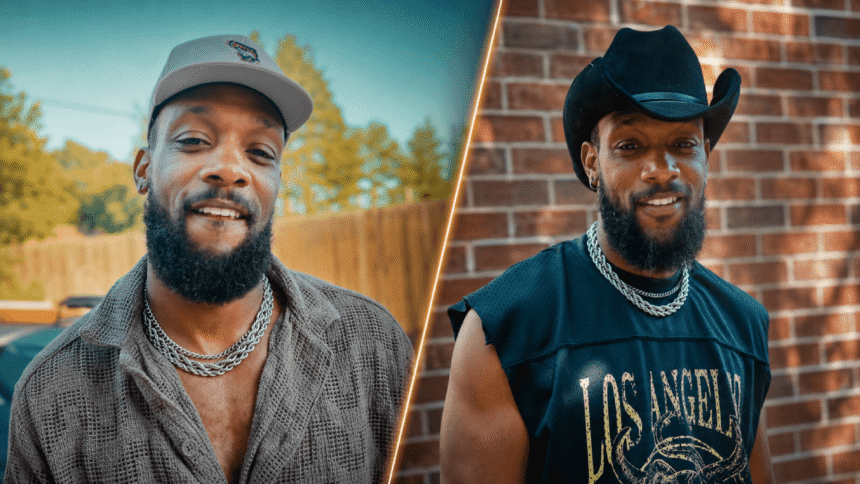
Bryan Hearne entered popular culture as a child performing material written by adults. Today, he works as a musician, poet and community organiser committed to deciding what his own stories mean.
Many viewers first encountered him as Andre Ray Peetes in the 2001 baseball drama Hardball or during his two-season run on Nickelodeon’s sketch series All That. More recently, his testimony in the documentary series Quiet on Set: The Dark Side of Kids TV prompted audiences to reconsider what happened behind the bright sets and exaggerated comedy of early-2000s children’s television.
The most revealing way to understand Hearne’s career is not as a rise, disappearance and comeback. It is a movement from performance to authorship—from interpreting somebody else’s idea of Black childhood to creating spaces where Black artists can speak for themselves.
Before Nickelodeon, There Was Hardball
Raised in Staten Island, New York, Hearne began acting professionally while still a child. His early television appearances included Third Watch, Providence and Nickelodeon’s Taina, while the comedy Pootie Tang gave him a small film role.
His most recognisable early performance came in Hardball. Keanu Reeves plays Conor O’Neill, a gambler who reluctantly coaches a youth baseball team in Chicago’s Cabrini-Green neighbourhood. Hearne appears as Andre Ray Peetes alongside an ensemble that includes a young Michael B. Jordan.
The film is generally remembered as an inspirational sports drama. Its structure, however, is built around an adult outsider whose personal redemption is achieved through his relationship with Black children. The players are funny, energetic and individually memorable, but their neighbourhood is largely presented through the adult protagonist’s discovery of poverty, danger and responsibility.
That distinction matters when revisiting Hearne’s work. He was already helping to humanise a story whose viewpoint belonged to somebody else.
For film travellers, Hardball also demonstrates why a screen location should never be mistaken for a complete account of a community. Chicago is more than a dramatic backdrop, and Cabrini-Green cannot be understood solely through the narrative functions assigned to it by Hollywood. Visiting a filming city responsibly requires looking beyond the movie’s emotional geography and learning how residents describe the place themselves.
What All That Offered—and What It Controlled
Hearne joined All That during its seventh season, when Nickelodeon relaunched the sketch-comedy programme with a new cast. The series offered young performers something exceptionally valuable: national visibility, regular screen experience and the opportunity to develop comic timing before a large audience.
It also placed children inside a production system where adults controlled the scripts, costumes, characters and acceptable limits of each performance.
In Quiet on Set, Hearne said that some of the material assigned to him relied on racial stereotypes. He specifically discussed playing a rapper named Lil Fetus and appearing in a sketch whose joke associated a Black child with selling an illicit product disguised as Girl Scout cookies. He also alleged that an adult working around the programme once referred to him using a derogatory comparison to charcoal.
These accounts should not be flattened into a vague claim that an old television programme was simply “problematic”. Hearne’s testimony identifies a more precise imbalance: a child performer could be highly visible while having very little authority over what that visibility communicated.
A sketch might last only a few minutes, but television repeats and preserves images. The performer eventually grows up; the character remains available in clips, reruns and online archives. That permanence gives writers and producers a responsibility extending well beyond whether an audience laughed during the original broadcast.
When Slapstick Stops Being Harmless
Hearne also participated in Nickelodeon’s SNICK On-Air Dare, a series of physical challenges involving members of the All That cast. The feature was sold as chaotic, messy entertainment, but Hearne later described experiences that made him uncomfortable, including having peanut butter placed on his body for dogs to lick.
The important question is not whether a stunt appears mild when described by an adult years later. It is whether the child understood what would happen, felt able to refuse and had an independent person protecting their interests.
Children working in entertainment occupy an unusual position. They are employees, but they are also minors responding to adult authority. They may recognise that refusing a sketch or stunt could disappoint producers, delay filming or threaten a rare opportunity. A signed form cannot remove that pressure.
This is why Hearne’s later recommendations carry more weight than celebrity nostalgia. In discussions following Quiet on Set, he argued for stronger safeguards and access to mental-health professionals who can monitor the welfare of young performers. His point was systemic: parents matter, but families entering the industry cannot be expected to understand every production practice or power relationship immediately.
The people with experience and institutional authority must also be responsible for keeping children safe.
Quiet on Set Changed the Frame
Hearne and his mother, Tracey Brown, appeared in Quiet on Set to describe their experience of his Nickelodeon years. Brown discussed challenging material she believed demeaned her son, while Hearne explained the lasting emotional consequences of being placed in those situations.
His participation gave the documentary something more valuable than behind-the-scenes trivia. It returned interpretive control to a former child actor.
The distinction is subtle but significant. Viewers had previously seen Hearne through characters created for him. In the documentary, he was not delivering a punchline or supporting another actor’s redemption story. He was analysing the conditions under which those performances had been produced.
Hearne’s allegations and recommendations are detailed in People’s interview about his experience as a child performer. Reading his account directly is more useful than consuming isolated clips stripped of their context.
The documentary’s cultural value therefore extends beyond exposing individual incidents. It asks audiences to reconsider how television history is constructed. A programme remembered fondly by viewers may be remembered very differently by the children who made it.
Both memories can exist, but they do not carry equal consequences.
Becoming HEARNE
After his early acting career, Hearne increasingly turned towards poetry, hip-hop and community work. Performing as HEARNE, he developed an artistic identity shaped less by commercial children’s entertainment and more by Black history, resistance and self-definition.
His 2020 EP I Won’t Move captures that change in authorship. Even the title expresses a refusal to be positioned by somebody else. Rather than inhabiting a character designed to fit a sketch, Hearne can determine the subject, language and political purpose of his work.
In 2024, he presented MARTYR: Hip Hop as a Form of Resistance at Washington State University Tri-Cities as part of a Black History Month programme. The performance connected music with the longer history of Black expression as testimony, protest and collective memory.
This is not an unrelated second career. Hearne’s music answers the central problem of his childhood work: who controls the image?
As a rapper and poet, he does not need to wait for an adult producer to decide which version of him is marketable. He can use performance to interrogate stereotypes rather than reproduce them.
Building Culture in the Tri-Cities
Hearne’s adult work is rooted in Washington’s Tri-Cities, far from the entertainment centres commonly associated with his screen career. There, he has worked as a musician, activist and co-leader of the Urban Poets Society, an organisation creating opportunities for local artists.
He shares that work with his wife, writer and poet Daishaundra Loving-Hearne. The couple received a Martin Luther King Jr. Spirit Award in 2021 for their contribution to the community.
Their work offers a useful correction to the conventional geography of creative success. Cultural influence does not belong exclusively to Los Angeles studios, New York theatres or major music-industry offices. It can be built through workshops, university events, open-mic nights and small organisations that give emerging performers an audience.
Travellers interested in contemporary culture often search for famous venues or locations connected to an established artist. Yet the more revealing destination may be a community arts space where reputations have not been manufactured yet. Those places show culture in the process of becoming.
A Tri-City Herald profile of Hearne’s music and community work describes an artist whose practice now combines poetry, performance, organising and Black liberation.
Why His Story Is Not a Comeback Narrative
It would be easy to describe Hearne’s return to public attention through Quiet on Set as a comeback. That framing would miss what he has actually built.
A comeback implies that mainstream visibility is the measure of whether an artist is present or absent. Hearne did not stop creating when he disappeared from nationally distributed television. He changed mediums, communities and priorities.
His journey also complicates the familiar story of the former child star. He is not merely revealing that fame had a hidden cost. He is demonstrating what can happen when a performer converts experience into cultural agency.
In Hardball, Hearne appeared inside an adult redemption narrative. On All That, he performed identities constructed in a writers’ room. In Quiet on Set, he supplied his own interpretation of that history. As HEARNE, he creates the material and helps other artists find places to create theirs.
That progression is the real through-line.
Bryan Hearne’s career asks audiences to look beyond recognition. The child on screen may be remembered, but was he heard? The adult artist has spent years answering that question—not by returning obediently to the old frame, but by building a new one.
Read more like on Jake Stormoen and the Independent Fantasy Career Built Across Continents.