


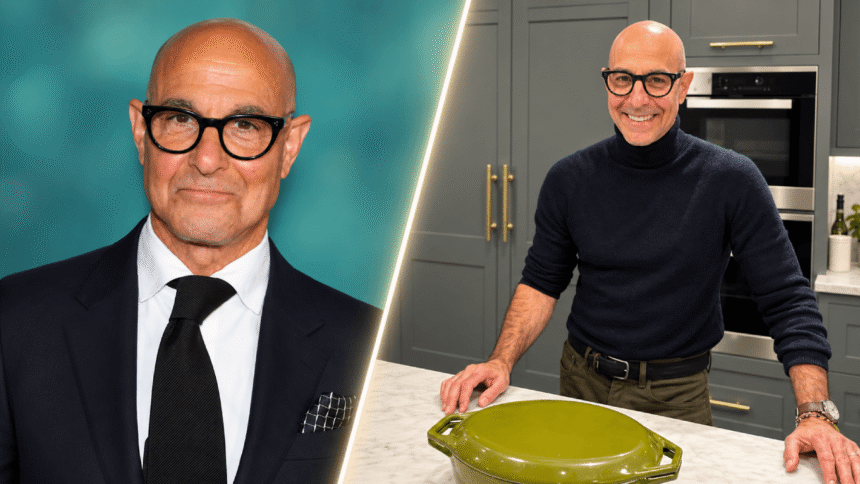
Stanley Tucci has become something increasingly rare: a character actor whose name now carries as much cultural weight as the stars he once supported.
For decades, he moved between dramas, comedies, blockbusters and independent films, often improving a production without demanding its centre. He could play a terrifying murderer in The Lovely Bones, a flamboyant television host in The Hunger Games or the impeccably observant Nigel in The Devil Wears Prada.
His career has since expanded beyond acting. Through cookbooks, memoirs and travel programmes, Tucci has become an unofficial ambassador for Italian food and regional culture. His lockdown video demonstrating how to make a negroni accelerated that transformation, turning an established performer into an unexpected lifestyle figure.
In 2026, all sides of his career converged. He returned as Nigel in The Devil Wears Prada 2, presented another season of Tucci in Italy and prepared to lead the international heist film Masterplan. National Geographic also announced Tucci in Great Britain, taking his culinary curiosity into the country he now calls home.
Stanley Tucci is no longer simply the familiar face who appears midway through a film. He has built a public identity around acting, food, style and the pleasure of paying attention.
Who Is Stanley Tucci?
Stanley Tucci is an American actor, writer, director, producer and television presenter born on 11 November 1960 in Peekskill, New York.
He grew up in an Italian-American family. His parents’ roots connected him to Calabria, while the family’s meals gave food a central role in daily life long before it became part of his professional identity.
Tucci also spent a year in Florence during childhood when his father took a sabbatical from teaching. The experience complicated his relationship with Italy. He arrived feeling strongly Italian-American but became more aware of his Americanness once living inside the country itself.
That tension later became useful in his travel work. Tucci approaches Italy with emotional familiarity but not as somebody claiming complete insider knowledge. He understands family traditions while remaining curious about regional distinctions that Italian-American culture can flatten.
After studying acting at the State University of New York at Purchase, Tucci began building a career through theatre and smaller screen roles. His first Broadway appearance came in The Queen and the Rebels in 1982, while his film debut followed in Prizzi’s Honor in 1985.
Becoming Hollywood’s Most Reliable Supporting Actor
Tucci’s early career developed through the kind of supporting roles that reward precision.
He appeared in films including Billy Bathgate, Beethoven, The Pelican Brief and It Could Happen to You. The parts varied in size, but they established his ability to suggest a complete personality quickly.
That skill is essential for a character actor. A leading performer may have two hours to explain a person’s choices. A supporting actor sometimes receives only a few scenes and must create an impression through voice, posture, clothing and rhythm.
Tucci became especially good at playing figures who understand the rules of the environment around them. His characters might be professionals, managers, criminals or confidants, but they frequently possess information that the protagonist lacks.
He can project refinement without warmth, authority without physical intimidation and humour without asking the audience to stop believing the scene.
Those qualities eventually made him equally useful to intimate dramas and large commercial franchises.
Why Big Night Remains Essential
Tucci’s most personal early film was Big Night, released in 1996.
He co-wrote, co-directed and starred in the story of two Italian immigrant brothers operating a struggling restaurant in New Jersey during the 1950s. Tucci plays Secondo, the practical brother attempting to keep the business alive, while Tony Shalhoub plays Primo, the chef unwilling to compromise his cooking for American customers.
The restaurant’s survival comes to depend on an elaborate dinner built around the promised appearance of a famous singer.
Big Night uses food to explore immigration, commerce, pride and the tension between authenticity and adaptation. Primo regards culinary compromise as betrayal; Secondo understands that a restaurant cannot preserve its principles if it closes.
The film avoids presenting either brother as entirely correct. Their conflict reflects the broader experience of immigrants attempting to maintain cultural identity while serving customers with different expectations.
The celebrated final kitchen scene contains almost no dialogue. Tucci’s character prepares an omelette, and the simple act communicates exhaustion, forgiveness and family connection more effectively than a speech could.
Long before his television journeys through Italy, Big Night established food as part of Tucci’s artistic language rather than a later celebrity hobby.
The Devil Wears Prada and the Creation of Nigel
Tucci reached another level of public recognition through The Devil Wears Prada in 2006.
He plays Nigel Kipling, the fashion magazine art director who helps Andy Sachs understand the professional world she initially dismisses. Nigel is witty and sharply dressed, but he is not merely the heroine’s amusing guide.
He has invested years in the magazine and understands that talent does not protect anybody from Miranda Priestly’s decisions. His disappointment when a promised career opportunity disappears gives the film one of its most revealing moments.
Tucci reportedly joined the production shortly before filming began. The apparent ease of his performance disguises how much work the role performs: Nigel explains fashion’s seriousness, humanises the workplace and demonstrates the personal cost of loyalty to Miranda.
Two decades later, Tucci returned alongside Meryl Streep, Anne Hathaway and Emily Blunt in The Devil Wears Prada 2, released in May 2026.
The sequel revisits a media industry transformed by digital publishing, changing advertising power and the decline of traditional magazines. Nigel remains valuable because he embodies institutional memory. He knows how the old system worked and what has been lost as fashion adapts to a different commercial reality.
The studio’s official page for the sequel confirms Tucci’s return as one of the original film’s central characters.
His appearance also carries a pleasing personal connection: Emily Blunt, who plays Miranda’s former assistant Emily, later became Tucci’s sister-in-law.
From The Lovely Bones to The Hunger Games
Tucci’s charm can make audiences forget how disturbing he can be.
In Peter Jackson’s The Lovely Bones, he played George Harvey, the man who murders teenager Susie Salmon. The performance removed the warmth and urbane humour associated with much of his work, replacing them with controlled menace.
Tucci received an Academy Award nomination for Best Supporting Actor. The recognition demonstrated that his familiar manner could become frightening when stripped of reassurance.
Soon afterwards, he moved into blockbuster entertainment as Caesar Flickerman in The Hunger Games films.
Caesar is the smiling television host who interviews children before they are sent into a lethal competition. His colourful hair, exaggerated laugh and relentless enthusiasm transform state violence into entertainment.
The performance is comic on the surface but politically important. Caesar is not the architect of the Games; he is the presenter who makes oppression appear glamorous and emotionally accessible.
Tucci understood that the character should never acknowledge the horror directly. Caesar’s professional skill lies in maintaining the programme’s tone regardless of what is happening around him.
The role introduced Tucci to younger audiences and became another example of his ability to occupy an unusual visual world without losing control of the character.
Conclave and the Power of Restraint
Tucci returned to awards-season attention through Edward Berger’s Conclave in 2024.
He played Cardinal Bellini, a liberal candidate involved in the secretive election of a new pope. Ralph Fiennes led the film as Cardinal Lawrence, the man responsible for organising the conclave while uncovering information capable of changing its outcome.
Bellini begins as a figure apparently guided by principle. As the voting develops, ambition and anxiety complicate that image.
Tucci’s performance avoids turning the cardinal into either an uncomplicated reformer or a hypocrite. He shows how institutional politics can transform moral conviction into strategy, particularly when participants believe the organisation’s future depends on their success.
The role suited Tucci’s talent for portraying intelligent men aware of how they appear to others. Bellini speaks carefully because every statement may influence an alliance.
It was quieter than Caesar Flickerman or Nigel, but the restraint reminded audiences why directors continue placing Tucci inside ensemble dramas: he makes thought visible.
How Food Created a Second Career
Tucci’s food career expanded dramatically during the pandemic.
In 2020, a video of him preparing a negroni at home became widely shared. The appeal lay partly in its timing. During a period of anxiety and confinement, Tucci appeared calm, precise and faintly amused while performing an ordinary domestic ritual.
The response was not based only on the drink. His clothes, kitchen, measured instructions and understated manner created an idealised image of adult competence.
Yet Tucci’s interest in food was already well established. He had written cookbooks and explored Italian-American cooking through Big Night. The viral video merely introduced that side of him to a larger audience.
CNN’s Stanley Tucci: Searching for Italy premiered in 2021 and followed him through Italian regions with distinct histories, landscapes and culinary traditions. The programme won two consecutive Emmys for Outstanding Hosted Nonfiction Series.
Its achievement was treating Italian cuisine as regional rather than universal. The food of Sicily does not tell the same historical story as the cooking of Lombardy, Tuscany or Calabria.
Tucci listened to farmers, chefs, historians and residents instead of presenting himself as the final authority. That curiosity distinguished the programme from celebrity travel series built primarily around the host’s reactions.
Tucci in Italy Season Two
After CNN ended Searching for Italy, Tucci continued the concept with National Geographic.
The second season of Tucci in Italy premiered in May 2026 and explored Naples and Campania, Sicily, Le Marche, Sardinia and Veneto.
Each episode examined how geography, conquest, poverty, migration and trade shaped what residents cook. Naples’ relationship with pizza cannot be separated from urban working life, just as Sicily’s food contains traces of the cultures that have occupied and traded through the island.
The series also resists the idea that “authenticity” means freezing a dish at one historical moment. Italian cooking has always changed in response to available ingredients, movement and necessity.
National Geographic’s official description of season two presents the programme as an exploration of the connections between land, people and food.
Tucci’s hosting style appears relaxed, but he has said presenting is harder than acting. A fictional role provides dialogue and a controlled character. Travel television requires him to remain genuinely responsive while cameras record encounters that cannot be rehearsed completely.
Why Tucci in Great Britain Makes Sense
National Geographic announced in 2026 that Tucci’s next culinary series would move into his adopted home.
Tucci in Great Britain is planned as a five-part journey through the country’s regions, examining local food, history and landscape. No complete release schedule had been announced at the time of writing.
The concept may surprise viewers who associate British cuisine with a limited collection of stereotypes. That is precisely why it has potential.
Britain contains distinctive agricultural, fishing and industrial food cultures. Scottish islands, Welsh farming communities, English coastal towns and multicultural cities cannot be represented by one national plate.
Tucci also occupies an interesting position as host. He lives in London but was not raised in Britain, allowing him to combine familiarity with an outsider’s curiosity.
The series could help perform for British food what his Italian programmes did for Italy: replace a simplified national image with regional complexity.
Masterplan Gives Him the Leading Role
Tucci will return to fictional entertainment in Masterplan, scheduled to reach Prime Video on 16 October 2026.
He plays a legendary thief who recruits an Italian cybercrime specialist and a French explosives expert to steal the Mona Lisa. He then reveals that the two recruits are long-lost siblings—and that he is their father.
The film co-stars Simona Tabasco and Victor Belmondo, combining a family-reunion comedy with an international heist story.
The premise gives Tucci a leading role tailored to his particular screen presence. A master thief requires intelligence, control, elegance and the ability to remain entertaining while withholding information.
It also reverses his traditional supporting position. Instead of advising or complicating another protagonist’s journey, Tucci becomes the figure designing the entire operation.
Cancer and the Loss of Taste
Tucci’s food work carries additional emotional weight because eating was once physically difficult for him.
He was diagnosed in 2017 with cancer at the base of his tongue. The tumour required chemotherapy and radiation treatment, leaving him unable to eat normally. He used a feeding tube for approximately six months and lost a significant amount of weight.
The experience was especially frightening because his first wife, Kathryn Spath, had died from breast cancer in 2009.
Tucci eventually entered remission, but treatment produced lasting effects. He has discussed difficulty swallowing certain foods and damage to his thyroid caused by radiation.
For somebody whose family life and creative identity revolve around food, the temporary loss of taste carried meaning beyond physical discomfort.
Its gradual return made eating and travel feel less like lifestyle branding and more like recovered pleasures. His programmes do not ignore appetite, but they understand that being able to taste, swallow and share a meal is not guaranteed.
Marriage, Family and Life in Britain
Tucci married Kathryn, known as Kate, in 1995. They had three children and also raised two children from her previous relationship.
After her death, Tucci later formed a relationship with British literary agent Felicity Blunt, the elder sister of Emily Blunt. They married in 2012 and have two children, Matteo and Emilia.
The family lives in London, which helps explain Tucci’s increasingly strong association with British cultural life.
Felicity’s work in publishing also intersects naturally with his writing. Tucci has published cookbooks and the food-centred memoir Taste: My Life Through Food, blending recipes with family history and reflections on illness.
His home life connects the different strands of his public identity. Acting remains the profession, but meals provide the structure through which he discusses family, memory and place.
Why Stanley Tucci’s Reinvention Worked
Tucci’s transformation into a food and style figure succeeded because it did not feel manufactured.
The ingredients were already present: an Italian-American upbringing, decades of cooking, Big Night, cookbooks, a carefully developed personal style and a genuine interest in regional history.
Social media and travel television made those qualities visible to people who knew his face but not his life.
His appeal also rests on restraint. Tucci does not behave as if every dish must cause an exaggerated emotional reaction. He allows cooks and communities to remain the focus, offering pleasure without turning travel into conquest.
At 65, he occupies a more influential cultural position than he did as a younger actor. That longevity challenges an entertainment industry obsessed with early breakthroughs.
Stanley Tucci’s career suggests that reinvention does not always require becoming somebody new. Sometimes it means recognising that the interests surrounding the work were part of the story all along.
Frequently Asked Questions
How old is Stanley Tucci?
Stanley Tucci was born on 11 November 1960 and is 65 years old.
Is Stanley Tucci Italian?
He is American and was born in New York, but his family is of Italian heritage.
Who does Stanley Tucci play in The Devil Wears Prada?
He plays Nigel Kipling, the fashion magazine’s art director and Andy Sachs’s mentor.
Is Stanley Tucci married?
Yes. He has been married to British literary agent Felicity Blunt since 2012.
How many children does Stanley Tucci have?
He has five biological children and also helped raise two children from his first wife’s previous marriage.
Is Stanley Tucci still making travel programmes?
Yes. Two seasons of Tucci in Italy are available, and Tucci in Great Britain has been announced.
Read more like on Kato Kaelin: The Houseguest Who Became a Symbol of the O. J. Simpson Trial.