

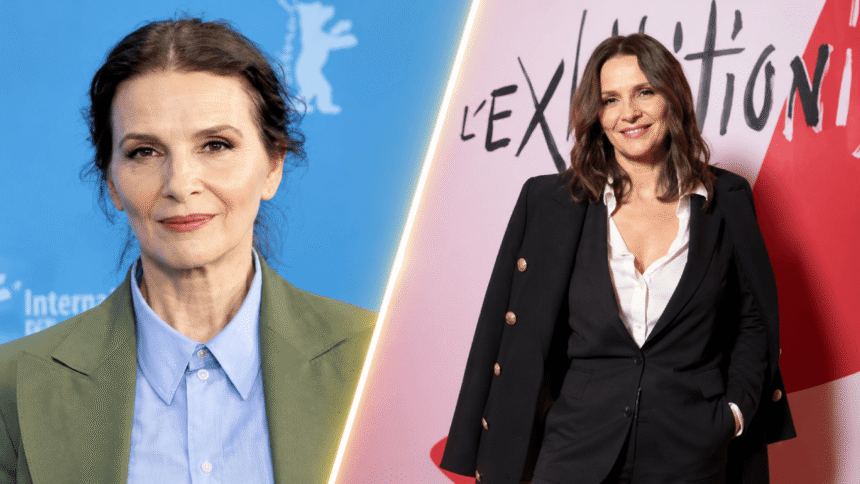
Juliette Binoche has spent more than four decades moving between French cinema, Hollywood, television, theatre and other art forms, building one of the most distinctive careers in international film. Born in Paris in 1964, the French actress has worked with filmmakers including Krzysztof Kieślowski, Michael Haneke, David Cronenberg, Olivier Assayas and Abbas Kiarostami, while maintaining a reputation for choosing emotionally demanding and unconventional roles.
In recent years, Binoche has taken on an increasingly visible role beyond acting. She presided over the jury of the 2025 Cannes Film Festival, exactly 40 years after she first appeared at Cannes with André Téchiné’s Rendez-vous. The festival described her career as spanning roughly 70 films and four decades of artistic curiosity.
Her work has earned some of cinema’s most prestigious honours, including the Academy Award for The English Patient, a BAFTA, a César and acting prizes at Berlin, Cannes and Venice. Yet her importance cannot be reduced to an awards list. Binoche has consistently used her career to move between commercial productions and demanding auteur cinema, often choosing characters whose emotional contradictions matter more than conventional glamour.
Who is Juliette Binoche?
Juliette Binoche is a French actress whose career began professionally in the early 1980s. She was born in Paris on 9 March 1964 and studied acting at the Conservatoire national supérieur d’art dramatique.
Her breakthrough came with André Téchiné’s Rendez-vous in 1985. The film was selected for Cannes and introduced Binoche to an international film community that would become central to her career. Four decades later, Cannes would return her to the festival in a very different role: president of the main competition jury.
The progression illustrates the unusual longevity of Binoche’s career. She did not simply become famous and remain within one narrow category of roles. Instead, she repeatedly changed direction.
Her filmography includes intimate European dramas, historical films, psychological thrillers, romantic films, literary adaptations and large-scale English-language productions. She has also worked in television, theatre, dance, music and painting. Cannes itself notes that her artistic work extends well beyond cinema.
Juliette Binoche and the Cannes Film Festival
Cannes has a particularly important place in Binoche’s story.
She first appeared at the festival in 1985 with Rendez-vous. In 2010, she returned to competition with Abbas Kiarostami’s Certified Copy and won the Best Actress prize.
Then, in 2025, she became president of the main competition jury.
Her appointment was significant because she followed Greta Gerwig and became part of a rare sequence in which one woman in cinema passed the prestigious role directly to another. Binoche chaired a nine-person jury that included Halle Berry, Jeremy Strong, Alba Rohrwacher, Payal Kapadia, Leïla Slimani, Dieudo Hamadi, Hong Sang-soo and Carlos Reygadas.
The position required her to judge 21 films competing for the Palme d’Or, making the role an extension of her decades-long relationship with international cinema.
Binoche’s comments during the festival also showed how seriously she viewed the cultural responsibility of the event. Speaking to journalists, she discussed cinema’s relationship with social and political change and the role of art in a world experiencing major upheavals.
The 2026 Cannes jury was subsequently headed by South Korean filmmaker Park Chan-wook, meaning Binoche’s term as president was a specific 2025 role rather than a continuing position.
The films that made Juliette Binoche internationally famous
Binoche’s career contains several defining films, but three in particular helped establish her international reputation.
The Unbearable Lightness of Being
Philip Kaufman’s 1988 adaptation of Milan Kundera’s novel gave Binoche one of her earliest major English-language roles.
Playing Tereza alongside Daniel Day-Lewis and Lena Olin, she demonstrated an ability to communicate vulnerability without turning the character into a passive romantic figure.
The film also helped establish her as an actress capable of moving naturally between French and English-language cinema.
The English Patient
Anthony Minghella’s The English Patient transformed Binoche’s international profile.
Released in 1996, the sweeping wartime romance became a major awards-season success. Binoche played Hana, a Canadian nurse caring for a badly burned patient in an Italian monastery during the final stages of the Second World War.
Her performance earned the Academy Award for Best Supporting Actress.
The Oscar mattered commercially and symbolically. Binoche had already established herself within European art cinema, but The English Patient demonstrated that she could bring the same emotional intensity to a major English-language production.
It also made her a familiar name to audiences who may not previously have followed French cinema.
Chocolat
Lasse Hallström’s Chocolat, released in 2000, offered another very different role.
Binoche played Vianne Rocher, a woman who arrives with her daughter in a conservative French village and opens a chocolate shop. The film combined romance, community drama and magical realism, earning several Academy Award nominations.
Vianne was warmer and more accessible than many of Binoche’s earlier dramatic characters, showing the range that has remained one of the defining characteristics of her career.
Her work with European auteur filmmakers
If The English Patient introduced Binoche to an enormous global audience, her collaborations with European directors explain why she remains so highly regarded among cinephiles.
She worked with Polish director Krzysztof Kieślowski on Three Colours: Blue, the first part of his acclaimed trilogy.
In Blue, Binoche plays Julie, a woman attempting to rebuild her life after a devastating personal loss. The performance required restraint rather than melodrama, and Binoche’s ability to convey grief through small physical details became central to the film.
She later worked with Michael Haneke in Caché, a tense psychological drama about guilt, memory and colonial history.
Her filmography also includes collaborations with David Cronenberg in Cosmopolis and Olivier Assayas in Clouds of Sils Maria, while her work with Abbas Kiarostami on Certified Copy earned her the Cannes Best Actress prize. Cannes lists these films among the important stages of her long relationship with the festival.
These choices reveal something important about Binoche’s career. She has rarely treated commercial success as the only measure of a worthwhile project.
She appears equally comfortable in films that demand patience and interpretation, where a performance may depend on silence, ambiguity or psychological tension.
The Taste of Things and Binoche’s later career
Binoche’s later work has shown that she has no interest in simply repeating the roles that made her famous.
In Trần Anh Hùng’s The Taste of Things, released in 2023, she played Eugénie, a cook working alongside chef Dodin Bouffant, played by Benoît Magimel.
The film is a romantic drama structured around food, labour and intimacy rather than conventional plot mechanics. Its detailed preparation of meals becomes part of the emotional language of the relationship.
The casting also carried an unusual real-life dimension: Binoche and Magimel had previously been partners and share a daughter.
Rather than turning that history into publicity, the film allowed the two actors to approach a complex fictional relationship after years apart professionally and personally.
The result fitted naturally into the later phase of Binoche’s career: mature, exploratory and uninterested in easy categorisation.
Juliette Binoche on television and stage
Binoche has never confined herself to film.
Her television work includes The Staircase, the HBO Max series about the complicated real-life case surrounding Michael Peterson and his family, and The New Look, in which she portrayed Coco Chanel.
These roles placed her in productions designed for global streaming audiences, demonstrating that her appeal extends beyond the traditional French and European film circuits.
She has also continued to work in theatre and dance. Cannes specifically highlights her collaborations with theatre director Ivo van Hove and choreographer Akram Khan, alongside her work with pianist Alexandre Tharaud.
That breadth helps explain why Binoche has remained relevant while many performers from her generation have become associated primarily with a particular era.
Her career has always been bigger than film alone.
Is Juliette Binoche married?
Juliette Binoche has not publicly been married, and she has generally kept her romantic life away from the centre of her public identity.
She has had several significant relationships during her life. Among the best-known was her relationship with actor Benoît Magimel, whom she met while making The Children of the Century. The couple later had a daughter, Hana, before separating.
Binoche also has a son, Raphaël, from her earlier relationship with professional diver André Hallé.
Because Binoche has two children and has had relationships with other well-known figures, online searches sometimes produce misleading descriptions of her family situation. A former partner should not be described as her husband, however, and there is no reliable basis for saying that she is currently married.
She has generally treated motherhood and family as private matters rather than subjects for celebrity publicity.
Juliette Binoche’s artistic activism
Binoche’s public identity has increasingly included outspoken views about the role of artists and the wider state of society.
She has spoken about climate change, political developments and the responsibilities of people working in culture. Her position is consistent with the broader idea that cinema is not isolated from the world around it.
That outlook was visible during her Cannes presidency. In interviews during the 2025 festival, she discussed the relationship between art and a world experiencing political and social upheaval.
Her activism can sometimes attract controversy, but it is also part of what distinguishes her from actors who prefer to remain entirely outside public debate.
For Binoche, acting has never been simply a profession. Her work across film, theatre, dance and visual art reflects a broader interest in creative expression and social questions.
What is Juliette Binoche doing now?
At 62, Binoche remains active across several areas of cinema and the arts.
Her recent work includes Queen at Sea, directed by Lance Hammer, in which she is also involved as a producer. She has also moved into directing, with In-I in Motion, a documentary connected to her 2008 stage collaboration with Akram Khan.
A recent Financial Times profile described Binoche as continuing to push against conventional expectations about what an established actress should do, including exploring directing and speaking publicly on cultural and political issues.
Her 2025 Cannes presidency provided a particularly visible reminder of her standing within international cinema. But perhaps the more interesting development is what comes afterwards.
Binoche is no longer simply protecting a famous acting career. She is expanding the definition of what that career can be.
Why Juliette Binoche remains important to cinema
There are younger actors with bigger social-media followings and performers whose commercial franchises generate larger headlines, but Binoche occupies a different kind of position.
Her importance comes from longevity, artistic credibility and range.
She has won an Oscar and major European acting awards. She has worked in blockbuster-scale productions and uncompromising art films. She has played historical figures, grieving mothers, romantic leads, psychologically complex women and characters whose motivations remain deliberately ambiguous.
Most importantly, she has continued to take creative risks.
The Cannes Film Festival’s own description of her career captures the scale of that achievement: around 70 films, four decades of artistic work and collaborations with filmmakers from across the world.
That makes Juliette Binoche more than an acclaimed French actress. She is one of the rare performers whose career has become part of the history of modern international cinema.
Frequently Asked Questions
How old is Juliette Binoche?
Juliette Binoche was born on 9 March 1964 in Paris, France. She is 62 years old in 2026.
What is Juliette Binoche best known for?
She is best known internationally for films including The English Patient, The Unbearable Lightness of Being, Chocolat, Three Colours: Blue, Caché and Certified Copy.
Did Juliette Binoche win an Oscar?
Yes. Binoche won the Academy Award for Best Supporting Actress for her performance in The English Patient in 1997.
Was Juliette Binoche married to Benoît Magimel?
No. Binoche and Magimel were partners and share a daughter, but they were not married.
Does Juliette Binoche have children?
Yes. She has two children: a son, Raphaël, and a daughter, Hana.
Was Juliette Binoche president of the Cannes Film Festival?
She was president of the main competition jury at the 2025 Cannes Film Festival. She presided over the jury that selected the Palme d’Or winner; she was not the director or owner of the festival.
Read more like on Miriam Shor: From Younger Favourite to Emmy-Nominated Director and Actor.