


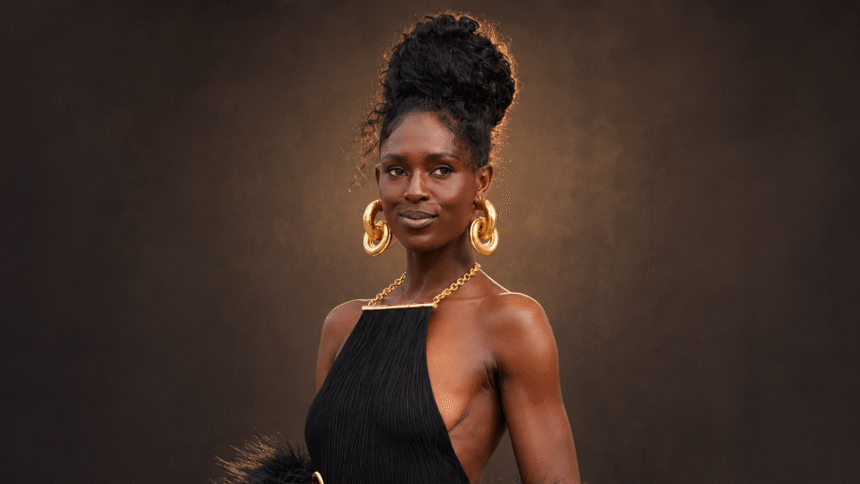
Jodie Turner-Smith has built a career out of refusing fixed identities. British-born, raised largely in the United States and shaped by her Jamaican heritage, she brings an instinctive understanding of movement to roles about fugitives, outsiders, immigrants, queens and people searching for home.
That background makes her work particularly compelling for travelers. Turner-Smith does not treat place as scenery. In Queen & Slim, After Yang, Anne Boleyn, Bad Monkey and The Agency, geography determines who feels safe, who holds power and who is permitted to belong.
Her career offers a sharper way to think about travel: crossing a border can change how other people see you, but it can also reveal how many versions of yourself were already there.
A Transatlantic Life Shaped by Jamaican Roots
Turner-Smith was born in Peterborough, England, in 1986 to Jamaican parents. She later moved to the United States with her mother and siblings, growing up in Maryland before attending the University of Pittsburgh.
Her story does not fit comfortably into a single national label. She is British by birth, connected to Jamaica through her family and culturally shaped by years spent in the United States. Rather than simplifying that background, she has allowed its tensions to inform her public voice and creative choices.
For travelers with families spread across countries, this experience will feel familiar. Home may be the place where someone was born, the country where they grew up, a relative’s kitchen or a language they hear more often at family gatherings than in daily life. Those attachments can coexist without forming a tidy answer to the question, “Where are you from?”
Turner-Smith’s screen presence frequently carries that complexity. She can appear assured while suggesting that her character is still evaluating the room, noticing its rules and deciding how much of herself to reveal. It is an invaluable quality for stories about displacement and belonging.
The Unplanned Route From Banking to Hollywood
Before acting became her profession, Turner-Smith worked in banking in Pittsburgh. Her route into entertainment reportedly changed after she met Pharrell Williams following a N.E.R.D. concert. She had considered writing; he encouraged her to explore modeling.
Turner-Smith moved to Los Angeles and began building a career through modeling, music videos and smaller screen appearances. Her early credits included True Blood, The Last Ship, Nightflyers and the Zayn Malik video for “Pillowtalk.”
The story sounds like a sudden discovery, but the useful part is what happened afterward. Her breakthrough did not arrive immediately. Years separated her first television appearance from the role that established her as a leading actor.
Los Angeles is filled with stories that compress a decade of uncertain work into one lucky encounter. Turner-Smith’s career resists that simplification. A chance meeting may have changed her direction, but persistence carried her along the new route.
That distinction matters beyond acting. Travel also encourages us to turn complicated lives into charming origin stories: the chef who abandoned an office job, the artist discovered in a village or the hotelier who restored a family property. The decisive moment makes good copy, but the less glamorous years usually explain the result.
Queen & Slim Turned the Road Movie Inside Out
Turner-Smith’s breakthrough came opposite Daniel Kaluuya in Melina Matsoukas’s 2019 film Queen & Slim. She plays an attorney whose unremarkable first date becomes a flight across America after a fatal encounter with a police officer.
The film borrows the visual language of the road movie—open highways, roadside stops, changing landscapes and temporary encounters—but removes the genre’s traditional promise of freedom. Movement does not liberate Queen and Slim. It offers only brief intervals of safety.
Turner-Smith’s performance is central to that reversal. Queen begins controlled and guarded, while Slim appears warmer and more willing to trust. As their journey continues, the emotional distance between them narrows even as the physical danger grows.
The locations do more than mark progress. Each stop reveals another America, connected to the same event through race, media and collective memory. A roadside bar, private home or mechanic’s workshop can become a sanctuary, but none exists outside the wider system pursuing the couple.
For travelers, the film exposes the limits of the phrase “the open road.” The same journey can represent discovery to one person and risk to another. Race, gender, money and citizenship travel with us; they affect which spaces feel welcoming and how freely we can move through them.
Turner-Smith does not allow Queen to become a symbol at the expense of being human. She is frightened, analytical, angry, desirous and occasionally wrong. That specificity prevents the film’s politics from flattening its central character.
Reimagining Anne Boleyn From the Inside
In 2021, Turner-Smith played Anne Boleyn in a Channel 5 miniseries that focused on the final months of the queen’s life. Casting a Black actor as the Tudor monarch predictably provoked debate, but the choice was not presented as a claim about Anne’s ethnicity.
Instead, the production used nontraditional casting to reconsider a historical figure whose appearance has often overshadowed her interior life. Turner-Smith’s performance emphasizes surveillance, isolation and the terrifying instability of favor at Henry VIII’s court.
The series offers a valuable lesson for heritage travel. Historic places are never neutral containers of fact. Palaces, portraits and plaques all reflect decisions about whose perspective deserves authority.
Visitors to a royal site may be shown architecture, succession and ceremony while learning far less about the servants, foreign diplomats, religious minorities or women whose lives made the institution possible. Changing the viewpoint does not change the surviving stone. It changes what we notice about it.
Turner-Smith’s Anne moves through familiar Tudor spaces as a woman becoming increasingly aware that the court has rewritten her from queen into obstacle. The tension comes not from discovering what happened—most viewers already know—but from seeing power withdraw its protection room by room.
In After Yang, Home Is a Collection of Memories
Kogonada’s After Yang gave Turner-Smith a quieter role as Kyra, a mother living in a near-future family with her husband Jake, their adopted daughter Mika and an android named Yang.
When Yang stops functioning, the family discovers the memories he recorded. These fragments are small: light moving across a room, a conversation, a face observed for a few seconds. Together, they form a life.
The film’s domestic world blends cultural references without pretending that identity can be manufactured through objects. Yang was acquired partly to help Mika connect with her Chinese heritage, but the arrangement raises an uncomfortable question: can culture be delivered to a child as a service?
Turner-Smith’s restrained performance helps keep the question personal. Kyra is not solving an abstract debate about technology. She is grieving a presence whose role in the family was more intimate than anyone fully understood.
For culturally curious travelers, After Yang is a reminder that heritage cannot be reduced to décor, food or a checklist of significant places. Those things can open a door, but belonging develops through attention, repetition and relationships.
From the Florida Keys to the World of Espionage
Turner-Smith brought a different energy to Bad Monkey, the Florida-set crime comedy adapted from Carl Hiaasen’s novel. As the mysterious Dragon Queen, she occupies a story filled with corruption, eccentricity and the uneasy collision between local life and outside development.
The Florida Keys are frequently sold as an uncomplicated escape: blue water, fishing boats and sunsets. Hiaasen’s world is less comfortable. Paradise is also a commodity, and the people who advertise it are often competing with those who must live with the consequences.
Turner-Smith’s character complicates the outsider’s view of the islands. She cannot be understood simply through the rumors surrounding her, and the performance plays cleverly with the assumptions other characters make.
In The Agency, Turner-Smith entered another world built around unstable identity. The espionage drama follows people whose professional lives require them to cross borders, construct cover stories and treat intimacy as a potential security weakness. Her role as Dr. Samia “Sami” Zahir gives the series an emotional center beyond its operational intrigue.
These projects look very different, but both ask who controls the story attached to a place or person. That question has become Turner-Smith’s most consistent territory.
Fashion as a Form of World-Building
Turner-Smith’s relationship with place continues on the red carpet. She approaches fashion less as decoration than as character creation, using sculptural silhouettes, saturated colors and dramatic jewelry to turn public appearances into miniature performances.
Her most memorable looks often draw from several visual traditions at once. Futurism can meet ceremonial dress; Old Hollywood glamour can be interrupted by an unexpected color or proportion. The result feels intentional without becoming predictable.
This is more than celebrity styling. Clothing is one of the first ways travelers negotiate a new environment. What we wear can signal respect, attract attention, provide protection or expose how little we understand local expectations.
Turner-Smith demonstrates that style can carry multiple histories without being confined to one of them. Her 2025 Vogue World appearance, which engaged directly with Afrofuturist aesthetics, made that principle especially clear. Afrofuturism does not merely imagine Black people in the future; it challenges the visual traditions that once excluded them from it.
Private Change Without a Public Reinvention Narrative
Turner-Smith married Canadian actor Joshua Jackson in 2019, and they welcomed a daughter in 2020. She filed for divorce in October 2023. The divorce was finalized in 2025, with the former couple agreeing to shared custody.
When discussing the end of the marriage, Turner-Smith rejected the idea that it should automatically be considered a failure. She described it instead as a transition from one meaningful period of life to another.
That perspective is consistent with her career. Turner-Smith does not appear interested in preserving one version of herself simply because it is familiar to the public. Her move from banking to modeling, from smaller roles to leading performances and from historical drama to science fiction reflects a willingness to change direction without disowning what came before.
There is a travel lesson in that, too. We often return from a significant journey and try to explain how it “changed everything.” Usually, change is quieter. A place gives us permission to reconsider a choice, identity or ambition that had already begun to feel too small.
The Value of Never Becoming Easily Placeable
Jodie Turner-Smith’s appeal lies partly in her resistance to easy classification. She can play a Tudor queen, a fugitive crossing the American South, a mother in a multicultural future, an enigmatic figure in the Florida Keys or a woman navigating the dangerous intimacy of international espionage.
The roles are connected by more than range. Each involves someone being interpreted by other people—often incorrectly—because of where she comes from, how she looks or the position she occupies.
Turner-Smith understands that identity changes according to the room. A person can be British in America, Jamaican in Britain, foreign in one setting and familiar in another. Travel makes these shifts visible, sometimes uncomfortably so.
Her work invites viewers to look beyond the surface of a destination and ask who is allowed to define it. That is a better question than whether a place matches its photographs. It turns travel from consumption into attention—and reveals why belonging is rarely as simple as arriving.
For more interesting one Read like on Robert Wuhl and the Art of Finding the Real City Behind the Myth.