


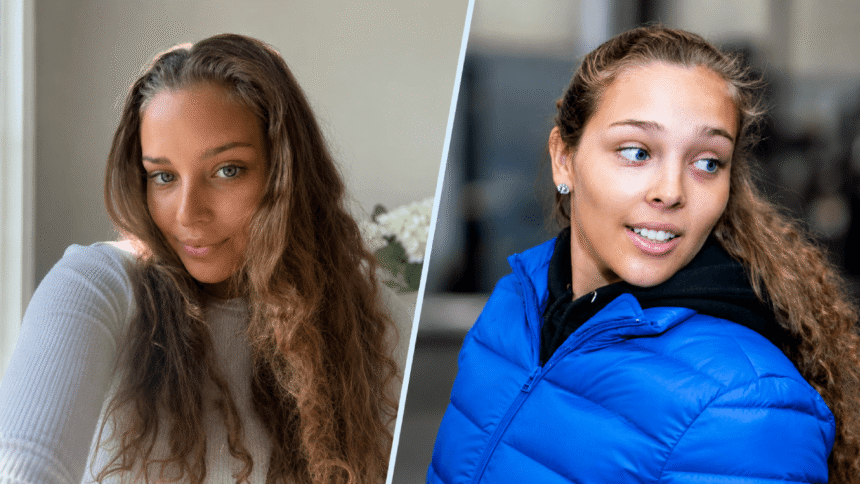
Janelle Larsson is frequently introduced as the daughter of Celtic and Sweden football legend Henrik Larsson. That connection explains why her name attracts interest in Britain, but it does not explain what she does.
Rather than following her father and older brother Jordan into football, Janelle has developed a professional career in showjumping. She has represented Sweden at youth championships, competed at international events and moved abroad as a teenager to build the experience required at senior level.
Her progress gained fresh attention in 2026 after she joined the Swedish Equestrian Federation’s Top U25 programme and finished sixth in a competitive two-star Grand Prix in Lier, Belgium. Now based in the Netherlands, she combines riding her own horses with training and competing horses for other owners.
The surname may open a familiar conversation, particularly among Celtic supporters, but Larsson’s results increasingly provide a separate reason to follow her career.
Who Is Janelle Larsson?
Janelle Maria Larsson is a Swedish professional showjumper born in Scotland on 28 February 2002.
Her place of birth reflects an important period in her father’s football career. Henrik Larsson was playing for Celtic in Glasgow at the time and had already become one of the club’s most celebrated goalscorers.
Janelle’s mother is Magdalena Spjuth, while her older brother, Jordan Larsson, became a professional footballer and Swedish international. The family therefore contains two generations of elite football experience—but Janelle chose a very different sporting environment.
Showjumping requires athletic ability, discipline and competitive judgement, yet the rider’s development cannot be separated from the horses available to them. Progress depends on building partnerships with individual animals, gaining access to experienced trainers and competing regularly at increasingly demanding heights.
Janelle began appearing in recorded competitions while still young and developed through Sweden’s junior and young-rider system. By her teenage years, she was already participating in significant national and international events.
As of 2026, the International Federation for Equestrian Sports lists her as an active Swedish jumping athlete with more than 1,100 recorded starts.
Growing Up in a Famous Sporting Family
Janelle’s childhood unfolded alongside the final stages of Henrik Larsson’s playing career.
She was born during his seven-year spell at Celtic, where he scored 242 goals and became one of the most revered players in the club’s modern history. The family moved away from Glasgow after Henrik joined Barcelona in 2004.
His career later included Manchester United and a return to Helsingborg, while his achievements with Sweden included a third-place finish at the 1994 World Cup.
Growing up around professional sport would have made the demands of elite competition familiar. Training schedules, travel, public attention and the emotional swings of winning and losing were part of the family environment.
However, equestrian sport presented Janelle with a distinct set of challenges. Henrik’s reputation could not clear a fence, develop a horse or guarantee selection for a Swedish team.
The comparison with Jordan is equally revealing. Her brother followed their father into professional football, playing for clubs in several European countries. Janelle instead established an identity in a sport where the Larsson name carried cultural recognition but little direct competitive advantage.
That difference has allowed her to acknowledge her family without simply recreating its football story.
Winning the Krafft Young Rider Cup
One of Larsson’s important early successes came at the 2019 Gothenburg Horse Show.
Aged 17, she won the final of the Krafft Young Rider Cup with Staralme Esc Z. She was the only competitor to complete both rounds without a jumping fault, demonstrating composure inside one of Scandinavia’s best-known indoor equestrian venues.
The victory mattered for more than its place on a results sheet. Gothenburg attracts experienced international riders and a knowledgeable audience, giving young competitors an opportunity to perform inside an atmosphere resembling senior elite sport.
Swedish Olympian Malin Baryard-Johnsson praised Larsson’s calmness after the performance. That quality is especially valuable in showjumping, where a rider must make rapid technical decisions without transferring anxiety to the horse.
A clean round depends on rhythm, stride length, balance and the route taken between fences. The rider must remain competitive against the clock while avoiding the rushed decisions that produce rails or refusals.
Larsson’s success with Staralme established her as more than a recognisable sporting daughter. It marked her as one of Sweden’s emerging equestrian prospects.
Representing Sweden at Youth Level
Larsson progressed through junior and young-rider competition while representing Sweden internationally.
At the 2018 European youth championships in Fontainebleau, she and Staralme Esc Z finished fifth in the individual classification. That result remains one of the strongest championship performances of her early career.
She returned to European competition in 2019 and later rode Kingston 43 at the 2021 young-rider championships in Vilamoura. Each appearance added experience across different courses, venues and levels of pressure.
The FEI’s official athlete profile records her championship participation, international starts, victories and changing world ranking.
Those records also illustrate why equestrian careers are rarely linear. A rider may achieve an outstanding junior result but require several more years to develop a suitable group of senior horses. An injury, sale or loss of form involving one horse can alter an entire season.
The transition out of age-group competition is particularly difficult. Young riders move from competing mainly against their peers to entering fields containing Olympians and professionals with decades of experience.
Larsson’s recent career has been about negotiating that transition.
Moving Abroad to Develop Her Career
Larsson left Sweden at 18 to pursue her equestrian ambitions elsewhere in Europe.
She initially developed her international experience in Belgium, one of the central countries in the European jumping industry. Belgium and the Netherlands contain dense networks of breeders, dealers, trainers, owners and competitions, making the region especially valuable for a young professional.
By 2026, Larsson was based at GDS Stables in the Netherlands with rider and trainer Vincent Hoorn. The move placed her inside a system where international competitions are readily accessible across several neighbouring countries.
Living abroad also transformed riding from an individual sporting pursuit into a full working life. Professional riders are responsible not only for the minutes spent inside a competition arena but for daily training, horse care, travel, communication with owners and long-term planning.
Larsson has several horses of her own while also riding animals placed with her for training and competition. This arrangement is common in professional showjumping. Developing horses for owners can provide income and experience, although the rider does not necessarily retain control of a successful horse permanently.
She completed a degree in business administration with a marketing focus while continuing to ride. That education has practical relevance in a sport where athletes often operate stables, manage sponsorship relationships and represent horses commercially.
The Top U25 Programme
Larsson was selected for Sweden’s Top U25 programme, an initiative designed to help promising riders bridge the gap between youth competition and senior international sport.
The programme brings riders into an elite development environment involving coaching, planning and professional support. Selection does not guarantee a future championship place, but it indicates that the Swedish system considers the rider capable of progressing further.
For Larsson, the timing was significant. By her early twenties, she had already spent several years abroad and accumulated extensive international experience. The next challenge was turning that experience into consistent results at higher fence levels.
In March 2026, she produced an encouraging performance at a CSI2* Grand Prix in Lier. Riding Jezebel over a technical 1.45-metre course, Larsson completed two clear rounds and finished sixth.
The Swedish Equestrian Federation’s report on the result described her as breaking into a field containing established international riders.
A sixth-place finish is not a career-defining championship victory, but its context matters. Double-clear Grand Prix performances demonstrate accuracy and control under pressure, while also generating ranking points and strengthening a partnership between horse and rider.
The Horses Behind Her Progress
Showjumping careers are built through partnerships rather than individual statistics alone.
Staralme Esc Z was central to Larsson’s junior success, including the 2018 European championship result and her Krafft Young Rider Cup victory. The mare helped introduce her to major arenas and increasingly difficult courses.
Kingston 43 became another prominent partner during her young-rider years. Together, they competed at championship level and appeared at prestigious international meetings, including Geneva.
Her more recent group has included Jezebel, Rose D’Amour van het Schaeck, Loxton van de Groote Kamps and Lector. Results from 2026 show Larsson competing across classes ranging from approximately 1.35 to 1.50 metres.
Jezebel played a particularly important role in her step towards senior Grand Prix competition. Larsson announced the mare’s retirement in August 2026, describing her as the horse she could consistently trust.
Retiring a successful horse can create both emotional and sporting uncertainty. A rider must preserve the animal’s welfare while developing another partnership capable of competing at the same height.
Rose D’Amour, Loxton and Lector give Larsson options, but each horse has different strengths, experience and development needs. Her next stage will depend heavily on whether one or more can become a consistent Grand Prix partner.
What Does an International Showjumper Actually Do?
Public attention often arrives through competition photographs, yet showjumping is largely built during ordinary mornings at the stable.
Horses require structured exercise, veterinary oversight, farriery, appropriate nutrition and recovery. Riders spend time improving strength and responsiveness without repeatedly jumping full competition courses.
Travel is another major component. European riders may compete in Belgium one week, France the next and the Netherlands shortly afterwards. Horses need specialist transport, documentation and carefully managed schedules.
The financial structure is equally demanding. Prize money is available, but it is not guaranteed and is often shared after expenses. Stabling, entry fees, transport, staff, equipment and veterinary care can make the sport extremely costly.
Many riders therefore operate through a mixture of horse owners, sponsors, training clients, sales and prize money. Building an independent stable requires business judgement as well as riding ability.
Larsson’s marketing education may prove useful as she develops this side of her career. Modern riders must communicate with owners and sponsors while maintaining a public profile capable of attracting support.
Life Beyond Henrik Larsson’s Reputation
British searches for Janelle Larsson will probably continue to be driven partly by affection for her father.
Henrik remains a particularly important figure at Celtic, where supporters remember his goals, loyalty and contribution to the club’s European campaigns. Janelle’s Scottish birth creates an additional connection to that period.
Yet describing her only as “Henrik Larsson’s daughter” becomes increasingly incomplete.
She has spent years building a career in a technically complex sport, moved abroad at 18, completed a business degree and represented Sweden independently. Her progress is measured through championship performances, clear rounds and the development of horses—not through inherited celebrity.
Family experience may have helped her understand professional pressure, but it could not perform the daily work on her behalf.
Her brother Jordan’s football career continued the most obvious Larsson tradition. Janelle’s choice is interesting because it expands the family’s sporting identity rather than repeating it.
The Goal of Reaching Sweden’s Senior Team
Larsson has been open about her long-term ambition: earning a place on Sweden’s senior showjumping team.
That is an exceptionally difficult target. Sweden has produced some of the world’s strongest riders and won major Olympic, European and world honours. Competition for team selection is therefore intense.
Selection requires more than one impressive Grand Prix. Riders need consistent results, suitable horses, experience at championship height and the ability to produce clear rounds when competing for a team rather than only themselves.
At 24, Larsson still has time to develop. Equestrian careers can extend much longer than those in many physically demanding sports because expertise and judgement often deepen with age.
Her 2026 results suggest progress, but not the completion of the journey. The retirement of Jezebel creates a new challenge, while her remaining horses must continue developing if she is to climb the rankings.
The next few seasons will show whether she can convert youth-level promise into sustained senior success.
Janelle Larsson already carries one of Sweden’s most recognisable sporting surnames. Her task now is to make it equally familiar inside international showjumping.
Frequently Asked Questions
Who is Janelle Larsson?
Janelle Larsson is a Swedish professional showjumper who has represented her country in international youth competition.
Is Janelle Larsson Henrik Larsson’s daughter?
Yes. Her father is former Celtic, Barcelona and Sweden footballer Henrik Larsson.
Where was Janelle Larsson born?
She was born in Scotland in February 2002 while her father was playing for Celtic.
Is Janelle Larsson related to Jordan Larsson?
Yes. Professional footballer Jordan Larsson is her older brother.
Where is Janelle Larsson based?
As of 2026, she is based in the Netherlands at GDS Stables.
What is Janelle Larsson’s career goal?
She aims to establish herself at senior international level and earn selection for Sweden’s showjumping team.
Read more like on Enzo Fernández: The Midfielder Carrying the Weight of a Record Transfer.