


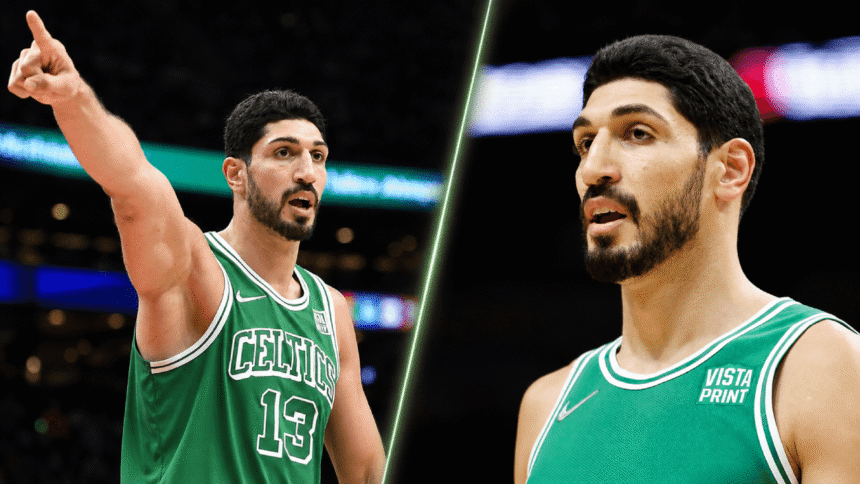
Enes Freedom has lived several public lives at once. He was an elite basketball prospect, an 11-season NBA centre, an outspoken opponent of Turkey’s government and a campaigner against human-rights abuses in China. More recently, he has become a divisive participant in America’s political culture wars.
Born Enes Kanter, he adopted the surname Freedom when he became a United States citizen in 2021. The change was both personal and calculated: it transformed the political principle at the centre of his activism into a permanent part of his identity.
His journey stretches from Switzerland and Turkey to basketball arenas across the United States. Yet the most revealing aspect of his career is not the distance travelled. It is the way exile changed an athlete into an activist—and activism gradually became a new form of performance.
By August 2026, Freedom was attracting attention for an attempted entry into the WNBA draft and a confrontation at a Chicago Sky game. Those events showed how far his public identity had moved from the NBA player once best known for rebounding and interior scoring.
Who Is Enes Freedom?
Enes Kanter Freedom is a Turkish-American former professional basketball player and political activist. He was born in Zurich, Switzerland, on 20 May 1992 and raised largely in Turkey.
Standing 6 feet 10 inches tall, Freedom developed into one of Europe’s most promising young centres. He played briefly for Fenerbahçe’s senior team before moving to the United States as a teenager.
He intended to play college basketball for the University of Kentucky, but the NCAA declared him permanently ineligible after determining that he had received benefits from Fenerbahçe beyond what was permitted for an amateur player.
The ruling prevented him from appearing for Kentucky, but it did not stop his professional rise. The Utah Jazz selected him with the third overall pick in the 2011 NBA Draft.
Over the following decade, he became a productive scorer and rebounder while playing for Utah, the Oklahoma City Thunder, New York Knicks, Portland Trail Blazers and Boston Celtics.
An NBA Career Built on Rebounding and Touch
Freedom was never a modern defensive centre or an especially versatile playmaker. His value came from traditional interior skills: rebounding, physical strength, offensive positioning and a soft touch near the basket.
Across 748 regular-season games, he averaged 11.2 points and 7.8 rebounds while shooting 54.8 per cent from the field. Those numbers describe a reliable rotation player rather than a franchise superstar.
His best statistical periods came with Oklahoma City and New York. With the Thunder, he became a powerful scorer off the bench and signed a four-year contract reportedly worth $70 million in 2015.
In Portland, he produced several memorable playoff performances. During the 2019 postseason, he played through a shoulder injury as the Trail Blazers reached the Western Conference Finals. He later returned to Portland and collected a franchise-record 30 rebounds against Detroit in April 2021.
Freedom’s official NBA profile records 11 years of league experience. That longevity is important when assessing his story. He was not simply an activist who briefly played professional basketball; he had a substantial NBA career before politics became his dominant public identity.
Why Did Enes Kanter Change His Name?
Freedom became a naturalised American citizen on 29 November 2021. At the same ceremony, he legally changed his name from Enes Kanter to Enes Kanter Freedom.
“Kanter” remained as a middle name, while “Freedom” became his surname. NBA jerseys subsequently displayed the new name.
The decision reflected his gratitude towards the United States after years of conflict with the Turkish government. It also formalised a personal reinvention that had already been underway for several seasons.
For Freedom, American citizenship represented security as well as symbolism. Turkish authorities cancelled his passport in 2017, leaving him briefly unable to travel after he landed in Romania. He was eventually permitted to return to the United States.
His legal name now functions almost like a campaign slogan. Every television introduction, book cover and speaking engagement repeats the political idea he wants associated with him.
That can be powerful, but it also creates a challenge. Once a person adopts a universal principle as a name, audiences inevitably judge whether all his public interventions live up to it.
His Conflict With Turkey and President Erdoğan
Freedom became a prominent critic of Turkish President Recep Tayyip Erdoğan, accusing Erdoğan’s government of authoritarianism, corruption and human-rights violations.
He also openly supported Fethullah Gülen, the US-based cleric whose movement Turkey blamed for the failed 2016 coup. Gülen denied directing the coup before his death in 2024. Turkey classifies his movement as a terrorist organisation, while Freedom has rejected accusations of terrorism.
The dispute had severe personal consequences. Turkish authorities revoked Freedom’s passport and issued warrants for his arrest. His father faced legal proceedings in Turkey, and Freedom said he reduced contact with family members because he feared they would be punished for their association with him.
He also avoided certain international journeys during his NBA career. In 2019, he did not travel with the New York Knicks to London, saying he feared assassination or abduction. Turkish officials dismissed those concerns, but American security authorities had reportedly advised him about threats.
Whatever one thinks of his later politics, his criticism of Erdoğan involved genuine personal risk. Exile was not a marketing device. It separated him from his birthplace and complicated his relationships with relatives who remained there.
Expanding His Activism to China
Freedom later broadened his campaigns beyond Turkey. During the 2021–22 NBA season, he wore customised shoes bearing messages about Tibet, Taiwan, Hong Kong and the treatment of Uyghur Muslims in China.
He criticised both the Chinese government and major companies he believed were benefiting from forced labour or remaining silent about abuses. He also challenged NBA stars, including LeBron James, over their commercial relationships with China.
Chinese streaming services reportedly stopped showing Boston Celtics games after Freedom’s statements. This placed him at the centre of an uncomfortable question for the NBA: could a league that celebrated political expression in the United States remain equally comfortable when that expression threatened access to an extremely valuable overseas market?
Freedom received the Geneva Summit Courage Award in 2022 for his advocacy. He has also used basketball camps and his charitable foundation to promote human rights and youth development.
His NBA career ended in February 2022 after Boston traded him to Houston and the Rockets waived him. Freedom has repeatedly suggested that his activism contributed to his disappearance from the league. NBA commissioner Adam Silver denied that he was being excluded for his political opinions.
There is no public document proving political retaliation. Basketball factors also mattered: Freedom was approaching 30, struggled defensively and played a style increasingly difficult to accommodate in the modern NBA. It is reasonable to recognise the commercial discomfort surrounding his activism without treating his explanation as conclusively established.
Life After the NBA
Freedom has not played professional basketball since 2022. He instead developed a second career involving speeches, political appearances, charitable events and media commentary.
His 2025 memoir, In the Name of Freedom: A Political Dissident’s Fight for Human Rights in the NBA and Around the World, presented his version of the transition from Turkish basketball prospect to American dissident.
The book positioned his NBA career as only one part of a larger argument about athletes and moral responsibility. Freedom has consistently maintained that prominent sportspeople should use their platforms rather than protect commercial relationships through silence.
He has hosted free basketball camps for young people and continued speaking about political prisoners, religious freedom and authoritarian governments. His foundation says it has supported hundreds of camps internationally, although such organisational figures are best understood as self-reported.
At the same time, his American political alignment became increasingly visible. He appeared alongside conservative politicians and organisations, criticised progressive activism and built a media profile extending well beyond his original campaigns concerning Turkey and China.
The 2026 WNBA Controversy
In August 2026, Freedom announced that he intended to enter the 2027 WNBA Draft, presenting the move as a challenge to transgender inclusion in women’s sport.
The declaration was widely interpreted as a political stunt rather than a genuine return to professional basketball. Freedom maintained that he was testing whether eligibility rules would be applied consistently and said he was defending fairness for female athletes.
The controversy escalated when he attended an Indiana Fever–Chicago Sky game on 23 August wearing a shirt defining a woman as an adult human female. During the match, he became involved in a heated exchange with Chicago guard Natasha Cloud and was escorted from his courtside seat by security.
Cloud has publicly supported transgender people. Freedom subsequently said he had been removed for supporting women, while critics accused him of deliberately provoking players and mocking transgender identities.
Sources connected to the league told Reuters that Freedom was not eligible for the WNBA. Freedom disputed reports that he had been formally rejected and described them as false.
No transgender woman has played in the WNBA, making his intervention largely symbolic. Rather than addressing an existing player dispute, it inserted him into a broader American political conflict.
From Dissident to Divisive Public Figure
Freedom’s transformation presents a difficult question: does consistency require defending every cause in the same way, or can an activist’s idea of freedom produce positions others view as exclusionary?
Supporters see continuity. To them, Freedom challenged Erdoğan, criticised China and now opposes policies he believes threaten women’s sport. In each case, they argue, he accepts hostility rather than remaining silent.
Critics see a fundamental change. They regard his campaigns for Turkish dissidents and Uyghurs as efforts to defend vulnerable people, but interpret his WNBA stunt as an attack on another marginalised group. The confrontation in Chicago reinforced the impression that provocation had become part of his political brand.
Both interpretations begin with the same truth: Freedom understands the attention economy. Custom shoes, direct challenges to celebrities, a symbolic surname and provocative public appearances all turn complex issues into memorable images.
That skill once allowed him to draw attention to political prisoners rarely mentioned during NBA broadcasts. It now risks reducing serious debates to culture-war theatre.
The Complicated Legacy of Enes Freedom
Freedom’s basketball legacy is straightforward. He was a gifted rebounder and interior scorer who sustained an 11-season NBA career, appeared in major playoff series and earned substantial contracts.
His political legacy is more unsettled. His opposition to Erdoğan cost him access to Turkey and placed pressure on his family. His criticism of China challenged the financial caution of the global sports industry. Those actions required courage.
Yet courage in one context does not place every later statement beyond criticism. His WNBA intervention shows how activism can shift from confronting powerful institutions to producing spectacles around vulnerable communities.
Enes Freedom remains interesting precisely because he resists a simple classification. He is neither merely a persecuted dissident nor merely a conservative provocateur. He is an athlete whose search for political purpose has made him influential, controversial and increasingly difficult to separate from the media conflicts he enters.
Frequently Asked Questions
What is Enes Freedom’s real name?
He was born Enes Kanter and legally became Enes Kanter Freedom in 2021.
Why did Enes Kanter change his surname?
He adopted “Freedom” when he became a US citizen to reflect his commitment to liberty.
Is Enes Freedom still in the NBA?
No. He last played in the NBA during the 2021–22 season.
Which NBA teams did Enes Freedom play for?
He played for Utah, Oklahoma City, New York, Portland and Boston.
Why cannot Enes Freedom return to Turkey?
Turkish authorities revoked his passport and issued arrest warrants connected to his political affiliations and criticism of Erdoğan.
Is Enes Freedom joining the WNBA?
No confirmed move exists, and league-connected sources have said he is ineligible for the draft.
Read more like on Britney Spears Net Worth: What Her Fortune Really Tells Us About Pop Stardom