


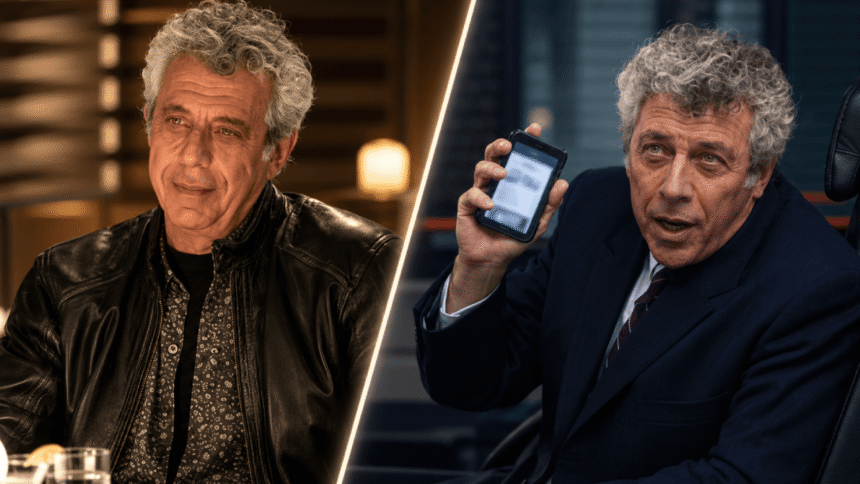
Daniel Molloy is the sharp-tongued investigative journalist at the centre of AMC’s adaptation of Anne Rice’s Interview with the Vampire. Played in the present-day storyline by Eric Bogosian and in flashbacks by Luke Brandon Field, Daniel begins the series as a sceptical human interviewer. By the end of the second season, he has exposed Armand’s manipulation of Louis de Pointe du Lac’s memories, published a bestselling book and become a vampire himself.
His importance continues in The Vampire Lestat, the retitled third season of AMC’s series, which premiered in June 2026. Daniel is no longer simply recording another vampire’s memories. He is now an immortal journalist interviewing Lestat de Lioncourt, whose version of events directly challenges the account Daniel published with Louis.
Daniel’s transformation, his unresolved connection to Armand and his refusal to accept convenient answers have made him one of the most compelling figures in AMC’s Immortal Universe.
The following article contains major spoilers for all three seasons.
Who is Daniel Molloy?
Daniel Molloy is a fictional journalist created by Anne Rice for The Vampire Chronicles. He is the interviewer who listens as Louis recounts his life with Lestat, Claudia and the Théâtre des Vampires.
In AMC’s adaptation, Daniel is an experienced investigative reporter with a successful but difficult career behind him. He has two Pulitzer Prizes, a complicated family history and Parkinson’s disease when Louis contacts him about conducting a second interview.
The television series significantly expands the character. Daniel is older than he was during his first encounter with Louis, giving the interviews an entirely different balance of power. He is no longer an impressionable young man fascinated by immortality. He is abrasive, observant and prepared to challenge contradictions in Louis’s account.
Daniel initially approaches the assignment as a final opportunity to produce an important book. What begins as an interview gradually becomes an investigation into memory, trauma and manipulation.
Why does Louis interview Daniel twice?
Daniel first met Louis in San Francisco in 1973, when he was a young reporter. During that encounter, Louis attempted to tell Daniel the story of his life, but the interview ended violently and remained unfinished.
Decades later, Louis invites Daniel to his home in Dubai and offers to repeat the interview. Daniel is seriously ill and initially suspects that Louis may have an ulterior motive. He nevertheless accepts because the project promises access to a story no other journalist could obtain.
Louis claims the second interview will correct the failures of their first meeting. However, Daniel soon discovers that neither version can be accepted without scrutiny. Louis’s memories contain inconsistencies, while Armand—initially introduced as Louis’s employee Rashid—controls access to information and frequently intervenes in the conversation.
Daniel’s function is therefore greater than that of a passive narrator. He tests testimony in the same way an investigative journalist might examine competing accounts of a real event. His questions gradually reveal that the official version of Louis and Armand’s history is deeply unreliable.
Eric Bogosian’s performance as Daniel Molloy
Eric Bogosian plays the older Daniel with impatience, intelligence and dark humour. The actor, playwright and author is known for projects including Talk Radio, Law & Order: Criminal Intent, Succession and Uncut Gems.
Bogosian’s performance avoids treating Daniel’s age or illness as signs of weakness. Although he is physically vulnerable in a home controlled by powerful vampires, his ability to recognise evasions gives him considerable authority. He regularly unsettles Louis and Armand by noticing details they would prefer to ignore.
The casting also changes the emotional character of the original story. Anne Rice’s first novel centres on an unnamed young interviewer who becomes overwhelmed by Louis’s account. AMC’s older Daniel has already experienced professional success, addiction, divorce and estrangement. Immortality is not a simple fantasy for someone who has spent decades confronting his own failures.
In The Vampire Lestat, Bogosian plays Daniel with a renewed physical confidence following the character’s transformation. His familiar scepticism remains, but it is now combined with vampiric abilities and an uncertain understanding of what his new existence will require.
Luke Brandon Field as young Daniel
Luke Brandon Field portrays Daniel during the 1973 flashbacks. His version is more impulsive and emotionally exposed than Bogosian’s older journalist, but the performances clearly represent the same character at different stages of life.
The younger Daniel meets Louis in a San Francisco bar and agrees to record his story. He is drawn into a psychologically dangerous encounter with both Louis and Armand, whose influence extends far beyond the incomplete interview.
These flashbacks explain why the older Daniel cannot remember parts of the night clearly. Armand altered his memories, concealing both the violence of the encounter and the complicated emotional dynamics among the three men.
Field’s performance is essential because it shows that Daniel’s aggressive questioning in Dubai is not merely professional stubbornness. He is unknowingly investigating something that happened to him. Each inconsistency in Louis’s story brings him closer to recovering his own past.
How Daniel exposes Armand’s deception
Daniel’s greatest achievement in the second season is identifying the truth about the trial at the Théâtre des Vampires.
Armand had allowed Louis to believe that he saved him from execution in Paris. That supposed rescue became a foundation of their relationship. By carefully comparing the participants’ memories and the surviving script of the trial, Daniel determines that Lestat—not Armand—was responsible for saving Louis.
Daniel presents the evidence directly, forcing Louis to confront the possibility that his relationship has been built around a lie. Louis attacks Armand and ends their decades-long partnership.
The revelation demonstrates why Daniel is indispensable to the story. Vampires possess supernatural strength, telepathy and extraordinarily long memories, yet they remain capable of deception and self-delusion. Daniel’s human skill—asking precise questions—proves more disruptive than any supernatural power.
Does Daniel Molloy become a vampire?
Yes. The second-season finale confirms that Daniel Molloy has become a vampire.
After Daniel exposes Armand’s deception, Louis leaves the journalist alone with Armand in Dubai. The programme initially withholds exactly what happens between them. Daniel later appears promoting his published book, Interview with the Vampire, wearing dark glasses and displaying a noticeably altered manner.
The final reveal shows his vampiric eyes. He also communicates telepathically with Louis, confirming that his transformation is complete. Louis identifies Armand as Daniel’s maker and reacts with concern about having left the two together.
Daniel’s transformation is particularly striking because Armand had previously claimed that he had never made another vampire. The act therefore carries emotional and narrative significance beyond an impulsive attack.
The circumstances surrounding the transformation were not fully shown when the second season ended. The series deliberately left unanswered questions about Armand’s intentions, Daniel’s consent and what passed between them after Louis departed.
Daniel Molloy and Armand’s relationship
The connection between Daniel and Armand is one of the most discussed parts of the character’s story. In Anne Rice’s novels, their relationship is developed most substantially in “The Devil’s Minion”, a section of The Queen of the Damned.
In the books, Armand follows Daniel around the world after the original interview. Their relationship evolves from pursuit and fear into companionship, dependency and romance. Daniel becomes increasingly desperate for Armand to give him the Dark Gift. Armand resists before eventually transforming him when Daniel is close to death.
AMC’s adaptation reorganises this history. Young Daniel and Armand meet in San Francisco, but Armand suppresses Daniel’s memories. The older Daniel then spends much of the Dubai interview confronting Armand without consciously remembering the full significance of their earlier encounter.
The television version has confirmed Daniel as queer, but it has not simply reproduced every stage of the novel’s relationship. Viewers should distinguish what appears in Rice’s books from what the series has established on screen.
Daniel becoming Armand’s first fledgling creates a permanent supernatural bond between them. Whether the programme develops that bond into the full “Devil’s Minion” relationship remains a central question rather than a settled fact.
Daniel Molloy in The Vampire Lestat
Daniel returned when the series shifted its focus from Louis to Lestat. The third season was renamed The Vampire Lestat, reflecting its use of Rice’s second Vampire Chronicles novel and Lestat’s decision to become a rock star.
The story takes place after Daniel’s book has exposed the existence of vampires. Lestat rejects Louis’s portrayal of their history and wants to give his own account. Daniel once again becomes the interviewer, placing him between two former partners with sharply conflicting versions of the past.
The arrangement is inherently unstable. Daniel has already demonstrated that he will not protect Louis from uncomfortable evidence, and there is no reason to expect him to accept Lestat’s account without challenge. His journalistic method remains crucial even though he is now part of the supernatural world he once investigated.
The third season, which premiered on AMC in June 2026, gives Daniel a new perspective on immortality. He has gained physical power and freedom from his terminal diagnosis, but transformation has not erased his emotional history or automatically provided fulfilment.
How the television character differs from the books
AMC’s Daniel is older, more accomplished and more confrontational than the interviewer introduced in Rice’s 1976 novel. The original character is young and captivated by Louis’s description of eternal life. At the end of the book, he asks to be made a vampire, angering Louis.
The series instead imagines what that young reporter might become after several decades. Daniel returns with the professional experience needed to recognise manipulation and the personal regrets that make immortality more morally complicated.
The chronology of his relationship with Armand has also changed. Events from “The Devil’s Minion” have been reworked rather than adapted in their original sequence. This allows viewers familiar with the novels to recognise important themes without knowing precisely how the television story will unfold.
The 1994 film adaptation of Interview with the Vampire took another approach. Christian Slater played the interviewer, credited simply as Malloy, opposite Brad Pitt’s Louis. The film preserved the character’s youth but did not explore the later relationship with Armand that became so significant in Rice’s wider mythology.
Why Daniel Molloy matters
Daniel gives Interview with the Vampire its sceptical intelligence. Louis, Lestat and Armand are all persuasive storytellers, but each has reasons to reshape the past. Daniel refuses to treat memory as objective simply because a vampire has had a century to rehearse it.
He also represents the consequences of hearing these stories. The interview changes him when he is young, returns to dominate his life when he is older and eventually draws him into immortality. He begins outside the vampire world but gradually becomes one of its most disruptive participants.
The second-season conclusion changes his role permanently. Daniel is no longer a mortal witness who can leave once the recorder stops. As a vampire, author and public figure, he has helped expose a hidden society while becoming part of it.
That contradiction makes Daniel Molloy central to the future of AMC’s Immortal Universe. He wants the truth, but he now belongs to a species whose survival has traditionally depended on secrecy.
Frequently Asked Questions
Who is Daniel Molloy?
Daniel Molloy is the journalist who interviews Louis and later Lestat in Anne Rice’s Vampire Chronicles. Eric Bogosian plays his older incarnation in AMC’s television adaptation.
Who plays young Daniel Molloy?
Luke Brandon Field plays Daniel in the 1973 flashbacks. His scenes reveal the character’s original interview with Louis and suppressed history with Armand.
Does Daniel Molloy become a vampire?
Yes. The second-season finale reveals that Armand transformed Daniel after Louis left them together in Dubai.
Are Daniel Molloy and Armand romantically involved?
They have an extensive romantic relationship in Anne Rice’s books. The television adaptation has established a powerful connection between them but has reworked the chronology, so their full on-screen relationship remains different from the novels.
What illness did Daniel have before becoming a vampire?
The television version of Daniel had Parkinson’s disease. His transformation into a vampire removes the immediate threat posed by his human illness.
Is Daniel Molloy in The Vampire Lestat?
Yes. Daniel returns as an interviewer in The Vampire Lestat, questioning Lestat about his life and his objections to Louis’s published account.
Read more like on Amélie Hoeferle: From The Hunger Games to Her Breakout Role in Sterling Point.