


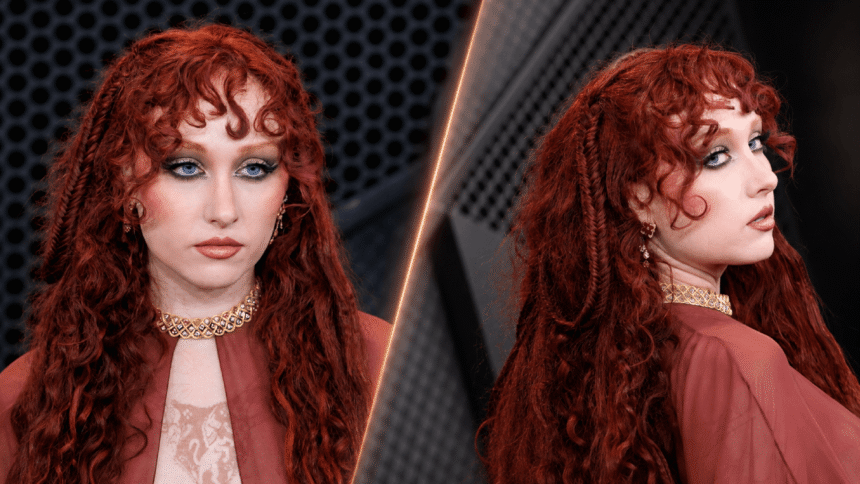
The Chappell Roan Grammy outfit 2026 was a custom deep-garnet Mugler gown suspended from simulated nipple rings and layered over a transparent, tattooed second skin. Designed under Mugler creative director Miguel Castro Freitas and styled by Genesis Webb, it became the most debated fashion moment of the 68th Grammy Awards.
Despite its convincing appearance, the construction did not depend upon real piercings. Prosthetic nipples created by make-up effects artist Sasha Glasser supported the illusion, while a nearly invisible base allowed sheer georgette to appear as though it hung directly from Roan’s body.
Temporary tattoos designed by Los Angeles artist Jenny Collins transformed the exposed skin into part of the outfit. The finished image combined late-1990s Mugler couture, medieval illustration, lingerie and theatrical body modification.
The look attracted attention because it appeared almost impossibly revealing. Yet its real importance lay in its construction. Roan was not simply wearing a “naked dress”; she and her creative team had turned the red carpet into a stage on which viewers had to determine where the body ended and the costume began.
What Did Chappell Roan Wear to the 2026 Grammys?
Roan arrived at the Grammy Awards on 1 February 2026 wearing a custom Mugler ensemble in a dark wine-red colour.
Its principal piece was a sheer, draped georgette négligée dress with an open front and back. The material appeared to connect to silver rings attached directly to her chest before falling loosely over her body and extending into a train.
A matching hooded cape initially covered more of the outfit. When Roan removed it, the full trompe-l’œil construction became visible.
She wore a transparent base incorporating prosthetic elements, meaning the dress was not actually being supported by her body in the way photographs initially suggested. The technical layer also provided a surface for some of the temporary tattoo work.
Genesis Webb completed the styling with gold Buccellati jewellery and dark, delicate footwear. The accessories were controlled because the gown and body art already supplied multiple visual focal points.
Roan later changed into a softer, pale draped gown when she appeared on stage to present the award for Best New Artist. The second outfit removed the tattoos and confrontational illusion, demonstrating how carefully the red-carpet image had been created for one specific entrance.
The Design Came from Mugler’s 1998 Couture Archive
The 2026 gown reinterpreted a look from Thierry Mugler’s spring/summer 1998 haute couture collection, titled Jeu de Paume.
In the original presentation, model Erica Vanbriel wore a sheer draped dress apparently attached to rings at the nipples. The design belonged to a collection filled with Mugler’s characteristic combination of exaggerated femininity, erotic spectacle and technical control.
Mugler regularly treated the body as material for transformation. His models became insects, robots, aquatic creatures, Hollywood sirens and superhuman figures. Clothing did not merely cover them; it reconstructed their silhouettes and identities.
The nipple-ring dress is a particularly concise example of that philosophy. Its fabric appears loose and almost fragile, yet the placement of the rings creates tension and gives the garment its entire structure.
Miguel Castro Freitas revisited the idea after becoming Mugler’s creative director. His spring 2026 collection had already echoed the 1998 design before Roan wore a customised red-carpet interpretation.
This made her Grammys outfit more than a direct archive loan. It was a conversation between the house’s founder, its current creative leadership and a musician whose own image depends upon transformation.
Vogue’s report on Roan’s 2026 Grammys entrance identified the custom Mugler design and documented how the sheer material appeared to hang from the rings.
Were Chappell Roan’s Nipple Piercings Real?
No. The nipple piercings were part of a prosthetic effect.
Sasha Glasser created prosthetic pieces that were applied to Roan’s body, while the dress and transparent foundation were engineered to maintain the illusion.
This distinction is important because much of the initial online reaction assumed the garment was literally hanging from real piercings. That interpretation made the look seem physically painful as well as revealing.
In reality, the outfit belonged to the tradition of trompe-l’œil fashion—clothing that deliberately tricks the eye.
Designers have used flesh-coloured panels, printed anatomy, sculpted breasts and transparent fabrics for decades. Mugler’s approach was especially theatrical because it combined the appearance of nudity with visible hardware.
The prosthetics also changed the relationship between exposure and performance. Viewers believed they were seeing Roan’s unaltered body, but the most discussed anatomical details were manufactured costume pieces.
That tension is central to her public image. Chappell Roan appears emotionally and visually uninhibited on stage, yet the apparent spontaneity is built through disciplined collaboration among designers, stylists, make-up artists and performers.
The Temporary Tattoos Created a Medieval Character
The dress alone would have attracted attention, but the temporary tattoos turned the outfit into a complete character.
Jenny Collins designed the intricate body art in collaboration with Webb and Roan’s team. Collins is known for detailed drawings influenced by medieval imagery, folk art and decorative illustration.
The designs covered Roan’s chest, back and lower body. They included ornamental patterns, lettering and figurative images, including a small pony reference connecting the look to her “Midwest Princess” identity.
A large lace-like back piece resembled an antique tapestry or illuminated manuscript. The placement made the tattoos appear simultaneously historical and contemporary: part medieval damsel, part rebellious modern pop performer.
The temporary nature of the work mattered. Permanent tattoos belong to the wearer’s continuing physical identity; these designs existed for one performance and disappeared when the costume changed.
They operated like embroidery applied directly to the skin.
Collins worked with the creative team to ensure the drawings did not compete randomly with the gown. Their brown-red colouring sat within the deep garnet palette, while the density of the body art gave visual weight to areas left uncovered by the fabric.
In an interview with Dazed, Collins described the project as an unusually genuine collaboration involving Roan, Webb and the wider styling team.
Why Her Make-Up Was Less Theatrical Than Usual
Chappell Roan is known for white face paint, exaggerated blush, graphic eyes and drag-influenced theatrical make-up.
For the 2026 Grammys, make-up artist Andrew Dahling deliberately exercised restraint.
The dress, prosthetics and temporary tattoos already required the viewer to process a large amount of visual information. Adding Roan’s usual highly graphic make-up could have fragmented the concept.
Dahling instead created a smoky eye influenced by the 1990s, with metallic liner adding controlled brightness. The complexion remained comparatively natural, while a muted red-nude lip connected the face to the gown.
He described the overall concept as a “Mugler medieval fantasy”. The phrase explains the balance: the tattoos supplied the historical fantasy, Mugler supplied the sculptural provocation and the make-up kept Roan recognisably human within both.
Her red hair was arranged into long braids with loose movement around the face. The styling suggested a storybook or Pre-Raphaelite figure without becoming a literal period costume.
Each beauty decision supported the central illusion rather than attempting to create a separate viral moment.
Genesis Webb Turned Fashion into Chappell Roan’s Visual Language
Stylist Genesis Webb has played a major role in constructing Chappell Roan’s public image.
Their work rarely treats clothing as a final decorative layer added after the music is complete. Each outfit creates a character or extends the world surrounding a particular performance.
Roan’s previous looks have drawn from drag, burlesque, horror, Renaissance portraiture, beauty pageants, Western clothing and theatrical camp. The references change, but the commitment to transformation remains consistent.
At the 2025 Grammys, she wore a vintage Jean Paul Gaultier couture gown printed with figures inspired by Edgar Degas. The dress and feathered headpiece presented her as a living painting during the ceremony at which she won Best New Artist.
Returning one year later created a difficult styling challenge. Repeating the same type of historical ball gown would have felt predictable, while adopting a conventional designer dress would have reduced the visual ambition that audiences now associated with her.
The Mugler look solved that problem by retaining couture history while changing its emotional effect. The 2025 Gaultier outfit was romantic, voluminous and painterly. The 2026 Mugler design was exposed, unsettling and physically confrontational.
Webb did not abandon Roan’s visual identity. She showed that it could move between radically different characters.
Why the Outfit Caused Such a Strong Reaction
The look divided viewers almost immediately.
Supporters described it as inventive, fearless and faithful to Mugler’s history. Critics considered it unnecessarily revealing or inappropriate for an awards ceremony.
Some of the reaction resulted from misunderstanding the construction. Images circulated with headlines suggesting that Roan had literally suspended the dress from her nipples. The more accurate explanation involving prosthetics and an invisible foundation arrived later.
The controversy also reflected familiar double standards around celebrity bodies.
Male performers can appear shirtless or in minimal stage clothing without their outfit becoming a moral debate. A female artist who controls a highly constructed image of exposure is more likely to be accused of seeking attention, despite attention being a central purpose of red-carpet fashion.
Roan’s outfit complicated that judgement because it was not straightforward nudity. The visible body had been altered through temporary tattoos and prosthetic anatomy. What appeared natural was largely designed.
The dress invited viewers to look and then mocked the confidence with which they believed they understood what they were seeing.
That is a more sophisticated use of exposure than simply selecting the least-covered garment available.
How Chappell Roan Responded to the Criticism
Roan appeared amused rather than defensive.
In an Instagram post after the ceremony, she said she did not consider the outfit especially outrageous. She described the look as strange and enjoyable while encouraging people to exercise their free will.
Her reaction was consistent with the playful philosophy behind her stage persona. She did not frame the gown as a solemn political statement or insist that every viewer admire it.
Instead, she treated fashion as an opportunity to experiment.
That lightness matters. Public discussion often places an exaggerated intellectual burden on women’s red-carpet clothing, demanding that every exposed body represent either empowerment or exploitation.
Roan’s response allowed for another possibility: the outfit could be technically impressive, historically informed and deliberately ridiculous at the same time.
She understood that the design would attract attention. She did not appear to regard other people’s surprise as evidence that something had gone wrong.
What Was Chappell Roan Nominated For?
Roan attended the 2026 Grammys as a two-time nominee.
“The Subway” received nominations for Record of the Year and Best Pop Solo Performance. She did not win either category.
Her presence still carried particular significance because she had won Best New Artist at the 2025 ceremony. During that acceptance speech, she challenged record labels to provide developing artists with liveable income and access to healthcare.
In 2026, she returned to present the Best New Artist award to Olivia Dean.
The outfit therefore accompanied a change in status. Roan was no longer the emerging performer waiting to learn whether the industry would accept her. She had become a previous major-category winner capable of using the red carpet independently from the evening’s results.
Even without receiving another trophy, she created one of the ceremony’s most widely circulated images.
The Second Outfit Completed the Story
When Roan appeared on stage, she replaced the Mugler look with a pale, flowing gown.
The change did more than provide additional coverage for television. It revealed how completely the first appearance had depended upon temporary construction.
The prosthetic elements and medieval tattoos disappeared. Cooler make-up tones and lighter fabric produced an almost angelic contrast with the dark red figure seen on the carpet.
Together, the outfits resembled two versions of the same fantasy character: the dangerous, exposed medieval figure and her softer ceremonial counterpart.
This type of change has become common at major awards shows, but Roan used it narratively. The second dress did not attempt to compete with the shock of the first. It allowed the first image to remain singular.
Why the 2026 Look Will Be Remembered
The Chappell Roan Grammy outfit of 2026 succeeded because a simple photograph communicated several contradictory ideas at once.
It appeared naked but depended upon multiple constructed layers. It looked medieval while drawing directly from 1998 couture. The fabric appeared fragile, yet the effect required substantial technical control. It seemed provocative, but Roan treated it as playful.
Most importantly, the outfit was immediately identifiable as hers even though its central idea originated decades earlier.
That is the difference between wearing an archive reference and activating one. Roan, Webb, Castro Freitas and the beauty team did not simply reproduce Mugler’s nipple-ring dress. They added tattoo illustration, prosthetic deception and the evolving mythology of the Midwest Princess.
The result was not universally admired, but universal approval was never the objective. The look was created to disturb the normal relationship between clothing, body and costume—and it accomplished that before Roan even entered the ceremony.
Frequently Asked Questions
Who designed Chappell Roan’s 2026 Grammy outfit?
The custom gown was created by Mugler under creative director Miguel Castro Freitas.
Were Chappell Roan’s nipple piercings real?
No. The look used prosthetics and an invisible base to create the illusion.
Who styled Chappell Roan for the Grammys?
Her longtime stylist Genesis Webb developed the look with Mugler and the beauty team.
Were Chappell Roan’s Grammys tattoos real?
No. Most of the visible medieval body art was temporary and designed by tattoo artist Jenny Collins.
What inspired the Mugler dress?
It reinterpreted a nipple-ring gown from Thierry Mugler’s spring/summer 1998 Jeu de Paume couture collection.
Did Chappell Roan win a Grammy in 2026?
No. “The Subway” received two nominations, but she did not win either award.
Read more like on Christopher Meloni Wife: Who Is Artist and Designer Sherman Williams?