


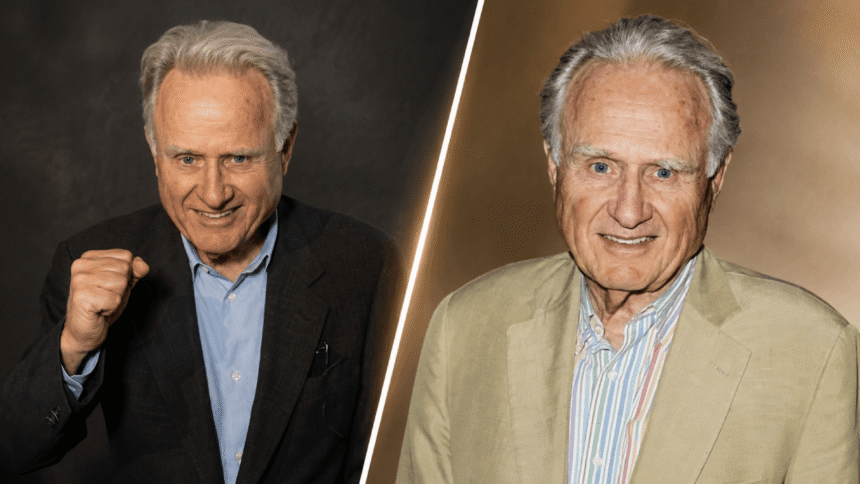
Larry Merchant became one of boxing’s most recognisable broadcasters by refusing to behave like a public-relations representative. During 35 years with HBO, he praised courage, questioned poor performances and asked champions the uncomfortable questions that frequently remained unanswered elsewhere.
For some viewers, Merchant was the conscience of boxing broadcasting: an experienced journalist prepared to challenge powerful fighters and promoters. For others, his commentary could be overly critical, stubborn or deliberately provocative. Both reactions reflect the same quality. Merchant treated boxing as a serious cultural subject rather than uncomplicated entertainment.
Now in his mid-nineties, Merchant remains closely associated with the era when HBO was one of the sport’s most influential broadcasters. Interest in him has also endured because clips of his post-fight interviews continue to circulate online—especially his extraordinary 2011 confrontation with Floyd Mayweather Jr.
In 2026, The Ring recognised Merchant with a Lifetime Achievement Award, bringing renewed attention to a career that began in print journalism long before he became a ringside television personality.
Who Is Larry Merchant?
Larry Merchant is an American sportswriter and retired boxing commentator. Born Larry Kaufman on 11 February 1931, he grew up in New York and later studied journalism at the University of Oklahoma.
He changed his surname from Kaufman to Merchant early in his career. Merchant has explained that concerns about antisemitism in the broadcasting and newspaper industries influenced the decision. “Merchant” served as an English translation of the meaning associated with his original family name.
Before television made him famous, he established himself as a newspaper journalist. He worked for publications including the Philadelphia Daily News and the New York Post, developing a reputation for colourful prose and an ability to place sport within a broader social context.
That background distinguished him from commentators who entered broadcasting primarily as former athletes. Merchant had not fought professionally, but he understood reporting, argument and storytelling. He approached a championship contest not only as a technical event but as a collision of ambition, commerce, personality and risk.
From Newspaper Columns to HBO Boxing
Merchant joined HBO Sports in 1978. Cable television was still developing, and HBO’s relationship with boxing had not yet become the institution remembered by later generations.
Over the following decades, the network helped transform how premium fights were presented. Its broadcasts combined strong production, experienced analysts, detailed scoring and documentary-style storytelling. Merchant became an essential part of that identity.
He worked alongside broadcasters and analysts including Jim Lampley, Barry Tompkins, Harold Lederman, Gil Clancy, Sugar Ray Leonard, George Foreman, Emanuel Steward, Roy Jones Jr. and Max Kellerman.
The roles within those teams were deliberately different. A play-by-play commentator described the immediate action, while former fighters explained tactics and technique. Merchant usually occupied the wider analytical position. He asked what the contest meant, whether a fighter had met expectations and how the result changed the sport’s hierarchy.
That approach could make a routine bout sound historically significant. It could also lead him to express disappointment when a heavily promoted fight failed to produce drama. Merchant did not believe that the existence of a major event automatically required him to call it a great one.
The Voice of HBO’s Biggest Nights
Merchant covered many of the defining fighters of the late 20th and early 21st centuries. His HBO career overlapped with the championship runs of Sugar Ray Leonard, Marvin Hagler, Thomas Hearns, Roberto Durán, Mike Tyson, Evander Holyfield, Lennox Lewis, Oscar De La Hoya, Bernard Hopkins, Roy Jones Jr., Manny Pacquiao and Floyd Mayweather.
His voice consequently became part of the memory attached to major fights. Viewers did not simply hear him during the contest. They encountered his analysis during the build-up and his interviews when fighters were exhausted, emotional and sometimes angry.
Merchant understood that a post-fight interview was not merely a victory celebration. A boxer might need to explain a controversial decision, a cautious performance, an illegal blow or an unexpected defeat. Those questions mattered precisely because the athlete would often prefer not to answer them.
His method brought journalistic tension into an environment shaped by promotional interests. Boxing broadcasters depend on relationships with promoters and fighters, but their credibility with viewers depends on maintaining some distance from those same figures. Merchant was unusually willing to make that distance visible.
Larry Merchant and Floyd Mayweather
The most famous Larry Merchant moment occurred after Floyd Mayweather defeated Victor Ortiz on 17 September 2011.
The fight ended in the fourth round under controversial circumstances. Ortiz had deliberately butted Mayweather and was penalised by referee Joe Cortez. After the action resumed, Ortiz continued attempting to apologise and embrace his opponent. Mayweather responded with a left hook and right hand while Ortiz was unprepared, producing a legal knockout.
During the post-fight interview, Merchant pressed Mayweather about the crowd’s negative reaction and the disputed ending. Mayweather became increasingly frustrated, accused Merchant of never treating him fairly and said HBO should dismiss him.
Merchant, who was 80 at the time, responded that if he were 50 years younger, he would physically confront the undefeated champion. The exchange instantly became one of the most replayed interviews in boxing history.
The argument was entertaining, but it also exposed a genuine disagreement. Mayweather believed Merchant approached him with an established negative judgement. Merchant believed his role required him to question the champion about an ending many viewers considered unsporting, even if it was legal.
The BBC’s contemporary report on the confrontation noted that Mayweather subsequently defended his reaction. The boxer later apologised, and Merchant said he accepted the apology before Mayweather’s 2012 fight with Miguel Cotto.
Their relationship remained a recurring subject because both men represented competing forms of authority. Mayweather possessed authority inside the ring; Merchant claimed the journalist’s authority to examine what happened there.
More Than One Memorable Argument
The Mayweather exchange dominates online clips, but it was not Merchant’s only confrontation with a fighter.
After Bernard Hopkins produced an uneventful victory over Morrade Hakkar in 2003, Merchant criticised the quality of the contest and questioned the value delivered to viewers. Hopkins responded by accusing Merchant of being well paid for doing little himself.
Merchant also challenged fighters over disputed judging, limited effort and unrealistic explanations. Following Vernon Forrest’s controversial victory over Ike Quartey in 2006, he interrupted Forrest’s list of thanks by asking whether the boxer also wished to thank the judges.
Such remarks delighted viewers who wanted sceptical journalism, but critics considered them disrespectful. That tension followed Merchant throughout his career. His sharpest questions could expose evasion, yet they could also make him appear more interested in producing confrontation than understanding a fighter’s perspective.
He occasionally made comments that aged poorly or required correction. His willingness to state strong opinions inevitably created mistakes as well as memorable insights. A fair assessment of Merchant must acknowledge both the independence that strengthened HBO’s coverage and the abrasiveness that sometimes distracted from it.
Why His Commentary Was Different
Merchant’s greatest quality was his sense of narrative. He could connect the immediate action to a fighter’s history, social background or place within boxing tradition.
His language often sounded more literary than conventional sports commentary. Years as a columnist taught him how to build an argument quickly and deliver a conclusion with rhythm. At his best, he could summarise the emotional meaning of a fight in a few sentences.
He was also comfortable with silence and reflection. Modern sports television often fears empty space, filling every second with statistics, promotion or exaggerated excitement. Merchant could pause before answering, giving the impression that the judgement mattered enough to consider carefully.
That deliberate style became slower as he aged, and some viewers found it frustrating. Yet it was central to his identity. Merchant did not sound interchangeable with anyone else on the broadcast.
The National Sports Media Association’s Hall of Fame profile recognises him as one of America’s leading boxing analysts and notes his journalism education at the University of Oklahoma.
Awards and Hall of Fame Recognition
Merchant received the Boxing Writers Association of America’s Sam Taub Award for excellence in boxing broadcast journalism in 1985. He later received further recognition from the organisation, including the Barney Nagler Award and A.J. Liebling Award.
He was inducted into the World Boxing Hall of Fame in 2002 and the International Boxing Hall of Fame in 2009. His inclusion in the latter was particularly significant because it formally placed a journalist alongside the fighters, trainers and promoters whose careers he had documented.
The 2026 Lifetime Achievement Award from The Ring added another major honour. It arrived more than a decade after his regular HBO career ended, indicating that his influence survived both his retirement and the closure of HBO Boxing itself.
Why Larry Merchant Left HBO
HBO announced in December 2012 that Merchant would conclude his regular broadcasting role after 35 years. His final assignment was the super-bantamweight fight between Nonito Donaire and Jorge Arce in Houston.
The departure was generally presented as the end of a long agreement rather than an abrupt dismissal. Merchant was 81, and Max Kellerman had already assumed an increasingly prominent position within HBO’s boxing team.
Claims that Floyd Mayweather directly forced Merchant to leave are not supported by the timeline. Their famous argument occurred in 2011, while Merchant continued working for HBO into late 2012 and interviewed Mayweather again.
After leaving his regular HBO position, he occasionally worked on international broadcasts and remained an observer of the sport. HBO itself stopped televising boxing in 2018, closing a 45-year chapter in American sports broadcasting.
His Health and Current Status
Merchant experienced a serious medical emergency in December 2023 and was admitted to hospital in Los Angeles. Initial reports described his condition as critical, causing widespread concern within boxing.
He later said he had been treated for vertigo and was recovering at home. His subsequent public appearances and the recognition he received in 2026 reassured admirers who had feared the worst.
As of September 2026, Larry Merchant is alive. He turned 95 in February and remains one of the last prominent links to several distinct periods of modern boxing history.
Larry Merchant’s Lasting Legacy
Merchant’s legacy rests on the idea that a boxing commentator should not simply advertise the next event. He believed viewers deserved judgement, context and questions that might make promoters or fighters uncomfortable.
That position sometimes led him into unnecessary conflict. It also gave HBO’s broadcasts an intellectual and journalistic seriousness that remains difficult to reproduce.
The Mayweather confrontation endures because it is dramatic, but Merchant’s career cannot be reduced to one angry interview. He spent decades explaining why fights mattered, examining the mythology surrounding champions and reminding audiences that courage inside the ring did not place anyone beyond scrutiny.
In a sport where access can encourage politeness, Larry Merchant made scepticism part of the show.
Frequently Asked Questions
How old is Larry Merchant?
Larry Merchant was born on 11 February 1931. He turned 95 in 2026.
Is Larry Merchant still alive?
Yes. As of September 2026, Merchant is alive. He recovered at home after being hospitalised in late 2023.
Why did Floyd Mayweather argue with Larry Merchant?
Mayweather objected to Merchant’s questions about the controversial ending of his 2011 fight with Victor Ortiz and accused the commentator of treating him unfairly.
Did Floyd Mayweather get Larry Merchant fired?
There is no reliable evidence that Mayweather had Merchant dismissed. Merchant continued working for HBO until December 2012.
How long did Larry Merchant work for HBO?
He joined HBO Sports in 1978 and ended his regular role in 2012, completing approximately 35 years with the network.
Is Larry Merchant in the Boxing Hall of Fame?
Yes. He was inducted into the International Boxing Hall of Fame in 2009 and has received several major awards for boxing journalism.
Read more like on Janelle Larsson: Showjumping Career, Famous Family and Swedish Ambitions.