


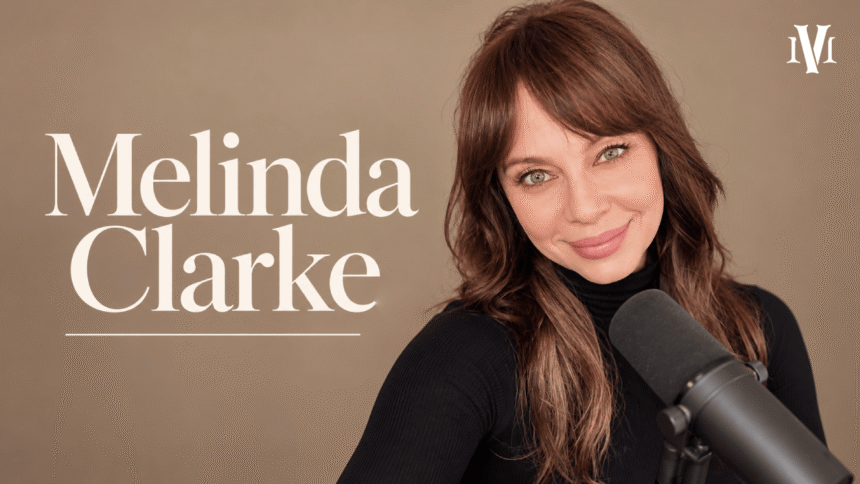
Melinda Clarke is best known to many viewers as Julie Cooper, the ambitious, sharply funny mother whose schemes helped drive The O.C. Yet her career extends across several distinct television worlds: the controlled menace of Amanda in Nikita, the enigmatic Lady Heather in CSI: Crime Scene Investigation and an early horror performance in Return of the Living Dead III.
More recently, Clarke has helped audiences revisit The O.C. through podcasts and interviews. There is one useful update for anyone searching for her current work: Beyond the OC, which she hosted with her daughter, CG Mirich, has concluded. Its final episode announcement says she decided it was time to move on from podcasting.
That retrospective work has encouraged a closer look at Julie Cooper, a character whose insecurity and vulnerability gradually became as significant as her appetite for status.
How Melinda Clarke Built Her Television Career
Clarke’s early television work included playing Faith Taylor in Days of Our Lives from 1989 to 1990. She later established herself across crime drama, fantasy, horror and prime-time serial storytelling.
The variety matters because her most recognisable characters can initially seem connected by a single quality: authority. They frequently enter a scene knowing what they want and expecting other people to respond.
However, authority works differently in each setting. In a crime procedural, it may create mystery. In a teen drama, it can expose the gap between adult confidence and private uncertainty. In an espionage thriller, it can become a weapon.
Clarke’s particular strength is making that confidence readable without explaining everything beneath it. A pause, a look or a carefully delivered remark can suggest that a character is assessing the room before deciding what to reveal.
That precision has made her effective in recurring roles as well as longer-running ensemble parts.
Why Julie Cooper Became Essential to The O.C.
The O.C. ran from 2003 to 2007, with Clarke playing Julie Cooper, the mother of Mischa Barton’s Marissa. While the younger characters supplied much of the romance and coming-of-age drama, Julie brought adult ambition, social anxiety and frequently disastrous decision-making into the picture.
At first, Julie’s priorities appear easy to identify. She values money, appearances and access to Newport Beach society. Her efforts to preserve that position can make her controlling, suspicious and painfully insensitive.
The performance becomes more interesting when those qualities are understood as connected. Julie is acutely aware that security can disappear. Her insistence on maintaining appearances therefore carries an undercurrent of fear, even when her behaviour is difficult to defend.
Clarke also understands the comic possibilities. Julie can make an outrageous remark with such certainty that the humour arrives before the other characters have finished reacting.
Over time, that combination allows the character to carry both broad comedy and emotional consequences. The same determination that produces a disastrous scheme can become recognisable as a survival instinct.
Is Julie Cooper a Villain or a Survivor?
Clarke has returned to this question in interviews. In a conversation recorded at Montreal Comiccon in 2024 and published by Citynet Magazine in April 2025, she discussed Julie’s complexity, the experience of playing characters labelled villains and how revisiting The O.C. changed her perspective.
The distinction between the interview date and publication date is useful: this was a later release of an earlier conversation.
Julie rewards that kind of reconsideration. A viewer watching as a teenager may primarily experience her as an obstacle to Marissa. An adult returning to the series may notice more of her financial insecurity, compromised choices and determination to avoid losing control.
Neither interpretation requires excusing the harm she causes. The dramatic interest lies in holding those ideas together: she can behave cruelly while remaining frightened, emotionally exposed and capable of change.
That is also why Clarke’s work remains central to discussions of the series. Julie gives the glossy setting a less comfortable question to answer: what does belonging cost someone who believes it can always be taken away?
Lady Heather and the Power of Restraint
Clarke’s recurring role as Lady Heather in CSI: Crime Scene Investigation offered a different expression of authority. Her appearances became associated with an unusual connection to William Petersen’s Gil Grissom, bringing a more personal register to the procedural.
Where Julie frequently reacts to a threatened position, Lady Heather often appears composed enough to let other people expose themselves first. Clarke’s restraint gives those scenes their tension.
The character also requires a respectful distinction between occupation and personality. Her work as a dominatrix is part of the story, but reducing her to that label misses the intelligence and emotional complexity that make her interactions compelling.
For Clarke, the role demonstrates how a recurring character can alter a programme’s atmosphere without appearing every week. Familiarity accumulates across appearances, allowing an exchange to carry meaning beyond the immediate investigation.
Amanda in Nikita: A More Dangerous Kind of Control
As Amanda in Nikita, which ran from 2010 to 2013, Clarke took on a character whose knowledge of other people becomes a means of manipulation.
In a 2012 interview with TV Guide, she discussed Amanda’s growing appetite for power within Division. Her explanation placed ambition and institutional control at the centre of the character’s behaviour.
Amanda’s menace often depends on an unsettling mismatch between manner and intention. She can speak with apparent calm while pursuing something deeply threatening.
That makes her a useful contrast with Julie. Both characters seek control, but their circumstances and methods differ substantially. Julie’s manoeuvres operate within family and social life; Amanda’s actions belong to a world of covert operations, coercion and betrayal.
Clarke gives each character a distinct emotional temperature, preventing a shared quality from becoming an identical performance.
Return of the Living Dead III and Her Horror Following
Before those television roles, Clarke starred as Julie Walker in Brian Yuzna’s Return of the Living Dead III, released in 1993. The American Film Institute describes a story centred on a young couple whose relationship becomes entangled with a military experiment and reanimation.
The film asks her to maintain an emotional connection with the audience beneath extensive horror imagery. The relationship remains important even as the circumstances become increasingly grotesque.
Its continuing life on home video has also preserved Clarke’s involvement in discussing the production. The Vestron Blu-ray release included a commentary featuring her and a separate interview about the film
For viewers who discovered her through The O.C., it reveals a markedly different early performance and helps explain her recognition among horror audiences.
What Happened to Her O.C. Podcasts?
Clarke and Rachel Bilson launched Welcome to the OC, Bitches! in 2021, revisiting episodes and speaking with people involved in the programme
She subsequently hosted Beyond the OC with CG Mirich. The format incorporated audience suggestions, episode discussions and interviews with cast and crew.
The official podcast archive now identifies its concluding instalment as the final episode. Clarke explained that the ending came earlier than planned and thanked listeners for their support. It should therefore be described as a completed project rather than an ongoing weekly commitment.
The archive nevertheless remains valuable. It records the perspectives of performers and production staff, giving viewers a fuller understanding of how a familiar television series was made.
Family Life and a Career Beyond One Character
Clarke is married to Adam Farmer, whom she married in 2015. She also has a daughter from her previous marriage, with their podcast collaboration bringing part of that family connection into her public work.
Her career is most rewarding when considered beyond Julie Cooper alone. Comedy, horror and suspense reveal different uses of the same precise delivery and attention to power within a scene.
Julie remains an enduring introduction, but Amanda, Lady Heather and Julie Walker show how much range sits behind that familiar Newport Beach image.
Frequently Asked Questions
Who is Melinda Clarke?
Melinda Clarke is an American actress known for The O.C., CSI: Crime Scene Investigation, Nikita and Return of the Living Dead III.
Who did Melinda Clarke play in The O.C.?
She played Julie Cooper, Marissa Cooper’s mother.
Was Melinda Clarke Lady Heather in CSI?
Yes. She played the recurring character Lady Heather in CSI: Crime Scene Investigation.
Who did Melinda Clarke play in Nikita?
She played Amanda, a powerful and manipulative figure within Division.
Is Melinda Clarke married?
Yes. She has been married to Adam Farmer since 2015.
Is Beyond the OC still producing episodes?
The podcast has concluded. Its final episode announcement states that Clarke decided to move on from podcasting.
Related reading: Nico Tortorella Wife: Who Is Bethany C. Meyers?.