


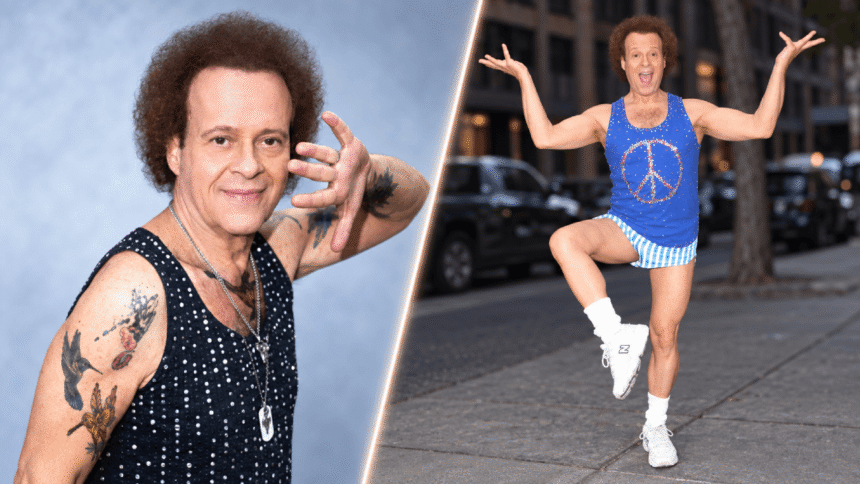
Richard Simmons built a career by making himself impossible to ignore. With his sparkling vest tops, striped shorts and irrepressible energy, he transformed exercise into theatre and became one of America’s most recognisable fitness personalities.
Away from the cameras, however, Simmons was intensely private. Interest in the entertainer continues to generate questions about his relationships, whether he ever had a wife and why he withdrew from public life. His death in July 2024 also produced early speculation before medical officials established what had happened.
The straightforward answers are that Richard Simmons never married and had no publicly known wife. He died at his Los Angeles home on 13 July 2024, one day after his 76th birthday. The Los Angeles County medical examiner ruled his death an accident caused by the consequences of blunt traumatic injuries, with arteriosclerotic cardiovascular disease identified as a contributing condition.
Those facts matter because Simmons spent much of his career surrounded by assumptions. Audiences knew his public character intimately, but that did not mean they knew the private man behind it.
Did Richard Simmons Have a Wife?
Richard Simmons did not have a wife. There is no credible public record of him ever marrying, and reliable accounts of his life describe him as having remained unmarried.
Searches for “Richard Simmons wife” sometimes produce misleading claims, partly because his surname is shared by numerous public figures and partly because unreliable celebrity websites tend to repeat unverified biographical information. Some results also confuse him with other people named Richard Simmons.
Simmons never publicly presented a spouse or long-term romantic partner. He was similarly guarded about his sexuality and did not believe that public curiosity entitled anyone to a definitive explanation. His flamboyant image led to persistent speculation, but clothing, mannerisms and performance style do not establish a person’s sexual orientation.
That distinction is especially important in Simmons’s case. His public persona was deliberately expressive, theatrical and emotionally open. Reporters and entertainers sometimes treated those qualities as an invitation to interrogate his private life. Simmons occasionally played along with jokes, but he also appeared hurt when interviews became more interested in labelling him than discussing his work.
He once described his relationship with his longtime house manager, Teresa Reveles, as being “almost like” a married couple. It was a comment about their closeness and shared domestic life, not confirmation of a marriage or romantic partnership.
Reveles began working for Simmons in the late 1980s and became one of the most important people in his household. After his death, she described their bond as affectionate and deeply loyal. Nevertheless, she was not Richard Simmons’s wife.
A Public Figure Who Kept Romance Private
Simmons devoted extraordinary attention to other people. He answered letters, made telephone calls to those seeking encouragement and remembered details about individuals who attended his classes. His emotional accessibility became central to his appeal.
Yet he revealed comparatively little about his own romantic history.
That imbalance may seem surprising in an era when celebrities routinely turn relationships into public content. Simmons belonged to a different media culture, although even by the standards of his generation he protected this area of his life particularly closely.
He once suggested that he had more to offer many people than he could offer one person. The remark captures the tension at the centre of his career: he created an unusually intimate relationship with a mass audience, but intimacy with millions could also leave little space for an ordinary private life.
It would be unfair to convert that privacy into a mystery requiring a sensational solution. The evidence supports only a limited conclusion: Simmons never married, did not have a publicly acknowledged spouse and chose not to define his romantic or sexual life for the public.
How Richard Simmons Changed the Fitness Industry
Born Milton Teagle Simmons in New Orleans on 12 July 1948, Simmons understood the emotional experience of weight gain long before he became a fitness instructor. He had struggled with his weight from childhood and later spoke about unhealthy dieting as well as the shame directed at larger people.
When he entered the fitness business, many gyms were designed for customers who already looked athletic. Simmons recognised the contradiction. The people most intimidated by exercise spaces were often those who most wanted help using them.
After moving to Los Angeles, he established an exercise studio initially called the Anatomy Asylum. It was later renamed Slimmons and operated in Beverly Hills for decades. The studio welcomed people across a range of ages, sizes and fitness levels.
Simmons’s method combined aerobics with encouragement, humour and an almost pastoral form of emotional support. He did not stand at the front of a room presenting himself as an unattainable physical ideal. He moved among participants, listened to their stories and made the experience feel communal.
His television career carried that approach into American homes. The Richard Simmons Show, which ran during the early 1980s, combined exercise, food advice and conversation. He also appeared on programmes including General Hospital, talk shows, game shows and late-night television.
The Sweatin’ to the Oldies workout videos became his defining commercial success. By using familiar music and participants who did not all resemble professional athletes, the series offered an alternative to the severe, body-conscious fitness culture often associated with the period.
There were limits to the weight-loss language of his era, some of which can sound dated now. Even so, Simmons’s underlying message was unusually humane: exercise should not be reserved for the already confident, and humiliation is a poor foundation for lasting change.
As the Associated Press’s account of his life noted, his television programme, books, studio and home-video empire turned personal experience into a vast motivational platform.
Why Did Richard Simmons Disappear from Public Life?
Simmons largely withdrew from public appearances in 2014. Because the change appeared abrupt, it generated rumours that ranged from illness to claims that he was being controlled inside his home.
The podcast Missing Richard Simmons intensified public fascination with his absence. Police conducted a welfare check in 2017 and said he was fine. Simmons also directly denied that Reveles was holding him against his will.
His explanation was less dramatic: after decades of constant public engagement, he wanted privacy.
Simmons experienced health difficulties, including knee problems, and later disclosed that he had previously been treated for skin cancer. But withdrawal should not automatically be interpreted as evidence of captivity, crisis or conspiracy. A person who has spent much of his adult life performing for strangers may eventually decide that he no longer wants to be seen.
He did not disappear completely. Simmons occasionally communicated through representatives and social media, particularly during 2024. He shared reflections, memories and messages encouraging followers to value their lives.
His decision to retreat challenged the expectations placed upon celebrities. The public had become accustomed to emotional access, and some fans interpreted the end of that access as something requiring investigation. Simmons appeared to see it differently: he had given decades of himself to the audience and was entitled to keep the remainder.
Richard Simmons’s Death
Richard Simmons died at his home in Los Angeles on 13 July 2024. He had turned 76 the previous day.
Initial reports did not provide a confirmed cause, which led to uncertainty online. The subsequent medical investigation established that his death was accidental.
According to the Los Angeles County Department of Medical Examiner, Simmons died from “sequelae of blunt traumatic injuries”. In plain language, that means he died from the consequences of injuries sustained in a fall. Arteriosclerotic cardiovascular disease was listed as a contributing condition.
Officials reported that Simmons experienced a fall on 11 July and remained in bed the following day. He was found unresponsive on his bedroom floor on the morning of 13 July, when emergency services were called. His death was pronounced at 9.45am.
The full findings described a ground-level fall and confirmed that the manner of death was an accident. The toxicology results did not indicate an illicit-drug overdose; reported substances were medications that had been prescribed or otherwise identified without being classified as the cause of death.
It is therefore inaccurate to describe Richard Simmons’s death simply as a heart attack or an unexplained natural death. Heart disease contributed, but the certified cause concerned the consequences of blunt traumatic injuries.
The Man Behind the Performance
Simmons was frequently treated as comic material during his lifetime. His clothes, voice and enthusiasm made him easy to imitate, and he was sufficiently media-aware to participate in the joke. But parody sometimes obscured the seriousness of his work.
He understood that weight was rarely only about food. Loneliness, grief, embarrassment, physical discomfort and years of criticism could all shape a person’s relationship with exercise. His great skill was making people feel noticed before asking them to change.
That is why reducing him to a collection of eccentric television appearances misses the point. Simmons was successful because he made fitness feel emotionally possible for people whom much of the industry ignored.
Questions about Richard Simmons’s wife or private relationships may continue, but the absence of a marriage is not a missing piece that invalidates the rest of his life. His closest relationships included family members, longtime colleagues, household staff and the enormous community of people who credited him with helping them move, lose weight or feel less ashamed.
His legacy is not that he looked or behaved like a conventional fitness expert. It is that he understood how many people conventional fitness culture had left behind.
Frequently Asked Questions
Did Richard Simmons have a wife?
No. Richard Simmons never married and had no publicly known wife.
Was Richard Simmons in a relationship?
He did not publicly confirm a spouse or long-term romantic partner. He kept his romantic life private.
Who was Teresa Reveles?
Teresa Reveles was Simmons’s longtime house manager and close companion. She worked with him for more than three decades, but she was not his wife.
When did Richard Simmons die?
He died on 13 July 2024, one day after his 76th birthday.
What was Richard Simmons’s cause of death?
The medical examiner recorded the consequences of blunt traumatic injuries from a fall as the cause. Arteriosclerotic cardiovascular disease was a contributing condition, and the death was ruled accidental.
What was Richard Simmons best known for?
He was best known for his inclusive fitness teaching, the Sweatin’ to the Oldies videos, The Richard Simmons Show, the Deal-A-Meal programme and his Beverly Hills studio, Slimmons.
Read more like on Joya Tillem: The Physician Married to Iron Man Director Jon Favreau.