


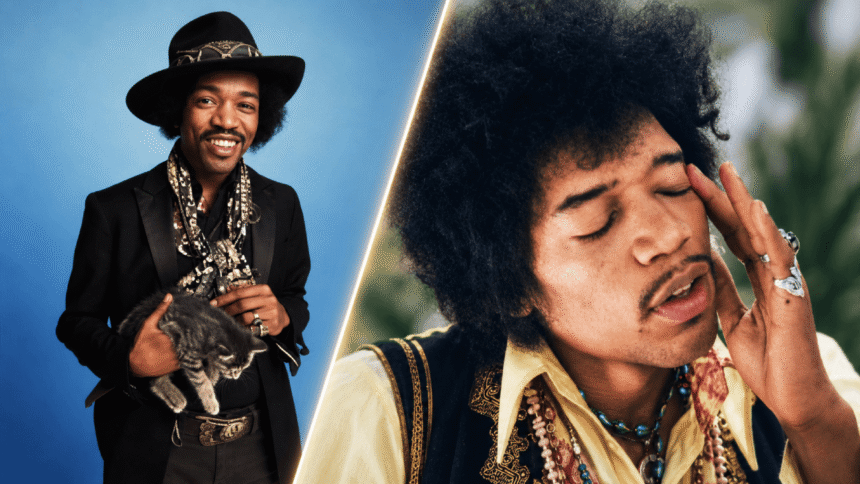
Jimi Hendrix died in London on 18 September 1970 after inhaling his own vomit while heavily sedated by barbiturates. The resulting obstruction deprived him of oxygen and caused fatal asphyxia. He was 27 years old.
A post-mortem examination identified the formal cause of death as inhalation of vomit due to barbiturate intoxication. Hendrix had reportedly taken several Vesparax sleeping tablets and had also consumed alcohol. The combination left him unable to respond normally when he became ill.
That medical conclusion is well established. What remains uncertain is precisely when he took the tablets, when he lost consciousness and whether medical assistance could have reached him sooner. Conflicting accounts of his final hours encouraged decades of speculation, but the coroner found no evidence proving either suicide or foul play. The inquest therefore returned an open verdict.
Where Did Jimi Hendrix Die?
Hendrix spent his final night at the Samarkand Hotel in Notting Hill, London. Despite its name, the property was a collection of serviced flats rather than a conventional hotel. He was staying in the basement apartment of Monika Dannemann, a German former figure skater with whom he had a personal relationship.
Dannemann found Hendrix unresponsive on the morning of 18 September. An ambulance was called at approximately 11.18am, and he was taken to St Mary Abbots Hospital in Kensington.
Doctors attempted to resuscitate him, but he showed no signs of life. Hendrix was pronounced dead at 12.45pm. Medical staff later indicated that he may already have been dead for some time before arriving at the hospital.
The apartment stood at 22 Lansdowne Crescent, only a short distance from the London neighbourhoods where Hendrix had established himself as a revolutionary musician less than four years earlier. London had created the conditions for his international breakthrough; it also became the setting of his premature death.
What Did the Post-Mortem Find?
Forensic pathologist Professor Robert Donald Teare conducted the post-mortem examination on 21 September 1970.
He found vomit within Hendrix’s airways and congestion in both lungs, evidence consistent with aspiration. Aspiration occurs when material such as food, liquid or vomit enters the respiratory system instead of being expelled or swallowed. If a heavily sedated person cannot cough or reposition themselves, the material can obstruct breathing.
Toxicology testing found barbiturates consistent with Vesparax in Hendrix’s blood. Vesparax was a strong prescription sleeping medicine containing two barbiturates. It was intended to be taken in much smaller quantities than the number reportedly consumed by Hendrix.
Alcohol was also detected. Although the alcohol level was not necessarily fatal by itself, alcohol can intensify the sedative effects of barbiturates. Together, they can suppress consciousness, coordination, breathing and the body’s protective reflexes.
The pathologist gave the cause of death as “inhalation of vomit due to barbiturate intoxication”. In practical terms, Hendrix became so deeply unconscious that he could not protect his airway after vomiting.
It is sometimes said simply that Hendrix died from an overdose. That description is incomplete. Barbiturate intoxication created the dangerous state, but asphyxia caused by aspiration was the direct fatal mechanism.
How Many Sleeping Tablets Did Hendrix Take?
Dannemann said that nine of her Vesparax tablets were missing. The prescribed dose was reportedly half a tablet, which would make nine tablets approximately 18 times the recommended amount.
However, no witness saw Hendrix swallow all nine, and the available evidence could not establish exactly when or why he took them. Toxicology supported substantial barbiturate consumption, but it could not reconstruct every action of the night.
European medications could also differ considerably from similarly named or familiar drugs elsewhere. Hendrix, an American, may not have understood the strength of the German-prescribed tablets. This has contributed to the widely accepted possibility that the consumption was accidental.
The danger of barbiturates was already well known in 1970. They have a relatively narrow margin between a sedating dose and a potentially lethal one, particularly when combined with alcohol. Their medical use later declined substantially as other sedatives became more common.
What Happened During Jimi Hendrix’s Final Night?
Hendrix spent part of 17 September with Dannemann. They reportedly visited a market, ate together and spent time at her apartment before Hendrix went to a gathering elsewhere in London.
He later returned to the Samarkand flat. At some point during the early morning, he consumed sleeping tablets and went to bed.
Beyond that basic outline, the timeline becomes less reliable. Dannemann gave different accounts of when she woke, when she realised something was wrong and what she did before calling an ambulance. Some of those differences may reflect trauma, confusion or imperfect memory; critics have argued that they reveal a more serious delay or concealment.
Ambulance personnel reportedly found Hendrix unconscious and unresponsive. Accounts also differ over whether Dannemann was present when they arrived. These contradictions have made it impossible to produce a universally accepted minute-by-minute reconstruction.
What can be stated confidently is that Hendrix was taken by ambulance to hospital and could not be revived. The medical evidence established how he died, even though the exact sequence leading to that outcome remained uncertain.
Was Jimi Hendrix’s Death a Suicide?
The official inquiry did not find evidence that Hendrix intended to take his own life.
In the hours before his death, Hendrix wrote a poem commonly known as “The Story of Life”. His friend Eric Burdon initially interpreted it as a suicide note and made comments to that effect. Burdon later withdrew that interpretation, acknowledging that he had misunderstood the writing.
The poem’s existence was not sufficient to establish suicidal intent. Artists frequently write about mortality, grief and uncertainty without intending self-harm, and the inquest found no clear evidence that Hendrix deliberately took a fatal quantity of medication.
Coroner Gavin Thurston concluded that the cause of death was clear but the circumstances and intention were not. He therefore returned an open verdict rather than ruling the death accidental or suicidal. Contemporary coverage in Rolling Stone’s report on the inquest likewise recorded the official conclusion as inhalation of vomit following barbiturate intoxication.
An open verdict does not itself imply suspicious activity. It means the evidence did not allow the coroner to determine reliably how the fatal situation arose.
Was Jimi Hendrix Murdered?
Various murder theories have appeared since Hendrix’s death, most notably allegations involving his manager, Michael Jeffery. One account claimed that Jeffery confessed to arranging Hendrix’s death for financial reasons.
Those claims have never been supported by evidence sufficient to overturn the original findings. The alleged confession emerged years later through disputed testimony, while several dramatic details repeated in books and documentaries have been challenged by researchers.
Former girlfriend Kathy Etchingham asked British authorities to reconsider the case in the early 1990s because of inconsistencies in Dannemann’s statements. Scotland Yard reviewed the available material but did not find a basis for a new criminal investigation.
Questions about the timeline are legitimate historical issues. They do not, on their own, prove murder. No person was charged in connection with Hendrix’s death, and no authoritative investigation has established that he was deliberately killed.
The responsible conclusion remains the medical one: he died after barbiturate intoxication left him unable to protect his airway. Whether he misunderstood the tablets’ potency, took them impulsively or made some other miscalculation cannot now be known with certainty.
His Health and State of Mind Before His Death
Hendrix had been experiencing exhaustion, irregular sleep and significant professional pressure. His career had accelerated with extraordinary speed after he arrived in London in September 1966.
Within months, the Jimi Hendrix Experience had transformed British rock. “Hey Joe”, “Purple Haze” and “The Wind Cries Mary” established Hendrix as a major recording artist, while his stage performances redefined what audiences expected from the electric guitar.
By 1970, however, the original Experience had dissolved. Hendrix faced contractual disputes, management tensions and uncertainty about his next musical direction. His Electric Lady Studios facility in New York had opened, offering him greater creative control, but it also brought financial obligations.
His final European tour included difficult performances and concerns about bassist Billy Cox’s health. Hendrix played his final full concert at the Isle of Fehmarn festival in West Germany on 6 September 1970. On 16 September, two days before his death, he joined Eric Burdon and War for an informal performance at Ronnie Scott’s jazz club in London.
Fatigue and stress provide context, but they do not establish intent. Hendrix was still making musical plans and exploring new sounds. The unfinished recordings released after his death show an artist moving beyond the psychedelic-rock format that had made him famous.
Why the “27 Club” Can Distort the Story
Hendrix is frequently grouped into the so-called 27 Club alongside Brian Jones, Janis Joplin, Jim Morrison, Kurt Cobain and Amy Winehouse. All died at the age of 27, leading popular culture to turn the coincidence into a symbol of doomed artistic genius.
The label is memorable but can flatten very different lives and deaths into one romantic myth. Hendrix did not die because brilliance inevitably destroys its owner. He died through a specific and preventable interaction of strong sedatives, alcohol, unconsciousness and airway obstruction.
Concentrating on the “curse” of being 27 can also distract from the limited understanding of drug interactions at the time and the risks created by exhaustion, unregulated schedules and easy access to powerful prescription medicines.
His death was tragic, but tragedy should not become glamour.
Hendrix’s Legacy Beyond His Death
Hendrix’s recording career at the highest level lasted barely four years. In that time, he transformed the vocabulary of electric guitar playing.
He combined blues phrasing, feedback, distortion, studio experimentation and showmanship without allowing technique to overwhelm emotion. Albums including Are You Experienced, Axis: Bold as Love and Electric Ladyland continue to influence rock, funk, metal, soul and experimental music.
His performance of “The Star-Spangled Banner” at Woodstock remains one of the defining musical statements of the era. Depending on the listener, it can sound celebratory, anguished, satirical or all three at once.
Hendrix was buried at Greenwood Cemetery in Renton, Washington, on 1 October 1970. His legacy is also preserved in London at the Handel Hendrix House, which includes the Brook Street flat where he lived during his rise to fame.
Frequently Asked Questions
What was Jimi Hendrix’s official cause of death?
He died from asphyxia after inhaling vomit while intoxicated with barbiturates.
When did Jimi Hendrix die?
Hendrix died on 18 September 1970. He was pronounced dead at 12.45pm.
How old was Jimi Hendrix when he died?
He was 27 years old.
Where did Jimi Hendrix die?
He was found unresponsive at the Samarkand Hotel in Notting Hill and pronounced dead at St Mary Abbots Hospital in London.
Did Jimi Hendrix intentionally overdose?
There was no evidence proving suicidal intent. The coroner recorded an open verdict because the circumstances could not be established conclusively.
Was anyone charged over his death?
No. Later allegations prompted renewed attention, but no investigation established that Hendrix was murdered.
The circumstances surrounding Jimi Hendrix’s last night contain unresolved contradictions, but the cause of death itself is not a mystery. Barbiturates left him deeply sedated, he vomited and he was unable to clear his airway. The open verdict reflects uncertainty about intention and timing—not uncertainty about the physical process that ended his life.
Read more like on Ludacris Net Worth: Music, Movies and the Business Behind His Fortune.