


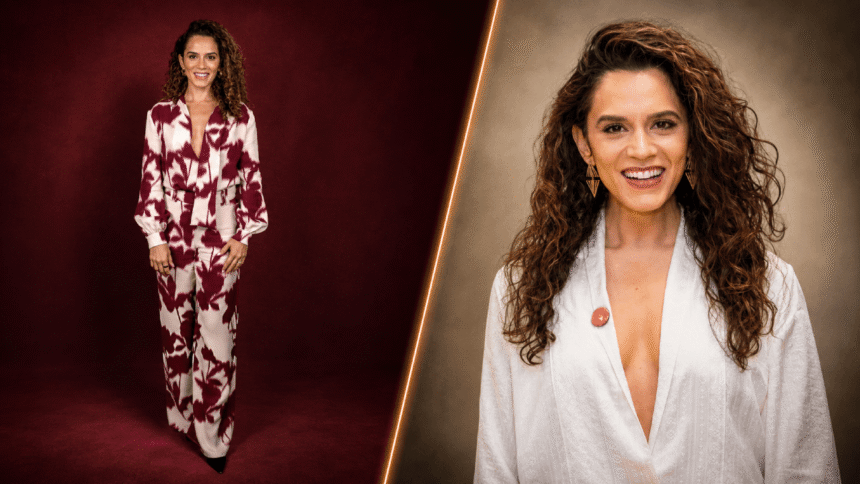
Sepideh Moafi has built a career around women who refuse to remain at the edge of somebody else’s story. From Gigi Ghorbani in The L Word: Generation Q to Dr Baran Al-Hashimi in The Pitt, her characters carry authority without losing their vulnerability.
That quality is rooted in an unusual personal and artistic journey. Moafi was born to Iranian parents in a refugee camp in Germany, trained as an opera singer and later moved into theatre and screen acting. She has also made refugee advocacy a sustained part of her public work.
Her career’s connecting thread is voice—not simply as sound, but as the power to be heard, represented and understood.
Born Into Displacement
Moafi was born in 1985 in a refugee camp in Germany after her parents fled Iran following the Iranian Revolution. Before reaching Germany, the family had spent time in Turkey while seeking safety and legal status.
They eventually received permission to move to the United States, where they rebuilt their lives. Moafi grew up speaking English while retaining a connection to Farsi and her Iranian heritage.
The experience of displacement became more meaningful to her as she grew older. Like many children trying to fit into a new country, she initially experienced aspects of her background as something that marked her as different. She has since described that history as a central source of empathy and purpose.
That perspective prevents her biography from becoming a simplistic tale of overcoming hardship. Displacement did not merely provide an inspiring opening chapter before Hollywood success. It continues to influence the roles she chooses, the questions she asks and the humanitarian work she supports.
Opera Taught Her How to Occupy a Room
Before acting became her main profession, Moafi trained seriously as a singer. She studied at the San Francisco Conservatory of Music, developing the technical control required for opera.
Opera demands more than vocal power. A performer must manage breath, language, posture and emotional expression while responding to music, other singers and the physical scale of a theatre. That discipline is visible in Moafi’s screen work, even when she speaks quietly.
She rarely appears uncertain about where a character’s centre lies. Her stillness has weight, and her dialogue often feels shaped by an understanding of rhythm. She knows when to accelerate through a thought and when silence will communicate more.
Moafi eventually became frustrated that traditional vocal training did not give acting equal importance. After recognising that dramatic performance interested her independently of singing, she pursued theatre and completed graduate acting training at the University of California, Irvine.
The transition was not a rejection of opera. It widened the range of instruments available to her. Instead of interpreting emotion through a score, she could build it from behaviour, language and relationships.
The Deuce Revealed Her Gift for Contradiction
After early television appearances, Moafi gained wider attention as Loretta in HBO’s The Deuce. Set around New York’s sex industry during the 1970s and 1980s, the series examines how commerce, policing, pornography and urban redevelopment reshape individual lives.
Loretta begins as a sex worker operating under the control of a pimp, but her story does not remain fixed in that position. As the pornography industry expands, she recognises an opportunity to gain greater control over her labour and future.
Moafi plays that evolution without turning it into an uncomplicated empowerment narrative. Loretta becomes more assertive, but the economic system around her remains exploitative. A different workplace does not automatically create freedom.
This is where Moafi’s performance becomes particularly useful to the series. She can suggest calculation and hope in the same expression. Loretta understands that she is making choices, but she also knows those choices are constrained by money, gender and race.
The programme’s Times Square is equally complicated. It is neither a purely dangerous district nor the sanitised tourism centre that later replaced it. Through characters such as Loretta, the city becomes a marketplace where survival and exploitation are frequently presented as opportunity.
Gigi Ghorbani Changed Who Could Be Seen in Los Angeles
Moafi’s most beloved role may be Gigi Ghorbani in The L Word: Generation Q. Gigi is an Iranian-American lesbian, a mother and a self-assured romantic figure whose cultural identity is part of her life without becoming her only storyline.
That combination carried unusual representational weight. Middle Eastern characters on American television have often been associated with immigration conflict, war or national security. Queer characters from the region have been even less visible.
Gigi enters the screen without asking permission to belong. She speaks Farsi, participates fully in Los Angeles queer life and experiences love, jealousy, parenting and desire with the same complexity afforded to the programme’s other women.
The importance of the character is not that she represents every queer Iranian person. No individual character could carry that responsibility. Her value lies in making such representation ordinary enough to support romance, humour and imperfection.
Los Angeles is essential to that achievement. The city has one of the largest Iranian communities outside Iran, yet mainstream television has rarely reflected how deeply Persian culture is woven into its social landscape. Gigi makes the programme’s version of Los Angeles more accurate by connecting identities that have always coexisted there.
Moafi has said that playing Gigi released a sense of freedom in her as a performer. That feeling reaches the audience: Gigi’s popularity comes not from being presented as morally flawless, but from appearing completely alive.
Black Bird Used Restraint as Suspense
In the Apple TV+ crime drama Black Bird, Moafi played FBI agent Lauren McCauley. The limited series follows Jimmy Keene, played by Taron Egerton, as he enters a dangerous prison and attempts to obtain information from suspected killer Larry Hall.
Lauren helps construct and manage that operation. Her role requires intelligence, control and an awareness that the plan’s psychological costs may exceed what anybody can predict.
Moafi’s performance avoids the familiar image of the emotionally detached federal agent. Lauren must remain professional while recognising the human risk created by institutional decisions. Her concern cannot become panic, but suppressing it completely would make the character unbelievable.
This tension suits Moafi’s strengths. She is especially effective when a person must project competence while privately absorbing fear or grief. The audience understands that Lauren is calculating several outcomes at once, even when the dialogue reveals only one.
Dr Al-Hashimi Made The Pitt Personal
Moafi joined the second season of HBO Max’s medical drama The Pitt as Dr Baran Al-Hashimi, an emergency-medicine attending physician introduced during a Fourth of July shift.
Al-Hashimi arrives with an efficient leadership style and experience in humanitarian medicine. Her methods create tension with Dr Michael “Robby” Robinavitch, played by Noah Wyle, particularly as she attempts to impose structure on an emergency department already shaped by trauma and exhaustion.
The role gradually reveals a more vulnerable reality. Al-Hashimi is living with a seizure disorder that could affect her ability to practise medicine. Her decision to conceal it turns professional confidence into a form of self-protection.
Moafi received her first Emmy nomination for the performance in 2026. The recognition reflects how much she communicates beneath Al-Hashimi’s controlled exterior. The character’s medical knowledge does not protect her from fear, and her authority does not eliminate the possibility of becoming a patient.
Moafi also drew on her humanitarian advocacy when developing the role. Her visits with refugees and healthcare workers helped her understand people who continue delivering care under extraordinary pressure.
HBO Max’s official description of The Pitt presents the series as an examination of modern American healthcare through its frontline workers. Al-Hashimi expands that perspective by connecting the Pittsburgh emergency department to medicine practised amid displacement and crisis.
Advocacy Is Not a Publicity Addition
Moafi has worked with the International Rescue Committee since 2019, supporting campaigns, fundraising efforts and public discussions about displaced people. She has also visited IRC programmes in Jordan, including services assisting refugees in the Zaatari camp.
Her connection to the organisation is personal, but she does not use her family’s history to suggest that every refugee experience is the same. Instead, it gives her a reason to listen to people facing present-day displacement.
This distinction matters. Celebrity advocacy can become symbolic—a photograph, a campaign slogan or a single appearance attached to a film release. Moafi’s involvement has continued across several years and different stages of her career.
The International Rescue Committee’s profile of Moafi describes work encompassing campaigns, panels, fundraising and direct engagement with refugee communities.
Her acting and advocacy consequently inform one another without becoming interchangeable. A fictional doctor cannot represent every humanitarian worker, but the research and relationships behind the performance can prevent the character from feeling abstract.
A Career That Connects Voice With Responsibility
Moafi has never travelled in a straight line from opera to television fame. Her work includes theatre, independent film, premium drama, queer television and humanitarian campaigning.
Yet the different parts fit together. Opera taught her how to use her voice physically. Acting gave her access to people whose contradictions could not be expressed through music alone. Advocacy turned public visibility into an opportunity to direct attention towards displaced communities.
Her most effective characters also change the places around them. Loretta exposes the economic machinery of old Times Square. Gigi makes Iranian queer life visible within Los Angeles. Lauren McCauley reveals the institutional pressure behind a prison operation. Dr Al-Hashimi connects an American emergency department with a wider world of humanitarian medicine.
Sepideh Moafi does not approach representation as the task of making every character admirable. She does something more valuable: she makes women from underrepresented backgrounds specific enough to be difficult, desirable, ambitious, frightened and fully human.
Frequently Asked Questions
Who is Sepideh Moafi?
She is an Iranian-American actor, singer and refugee-rights advocate.
Where was Sepideh Moafi born?
She was born in a refugee camp in Germany in 1985.
What is Sepideh Moafi best known for?
She is known for The Pitt, The L Word: Generation Q, The Deuce and Black Bird.
Who does Sepideh Moafi play in The Pitt?
She plays emergency physician Dr Baran Al-Hashimi.
Did Sepideh Moafi study opera?
Yes. She trained at the San Francisco Conservatory of Music.
Is Sepideh Moafi an Emmy nominee?
Yes. She received her first Emmy nomination for The Pitt in 2026.
Read more like on Hayden Panettiere Brother: Remembering Actor and Artist Jansen Panettiere.