


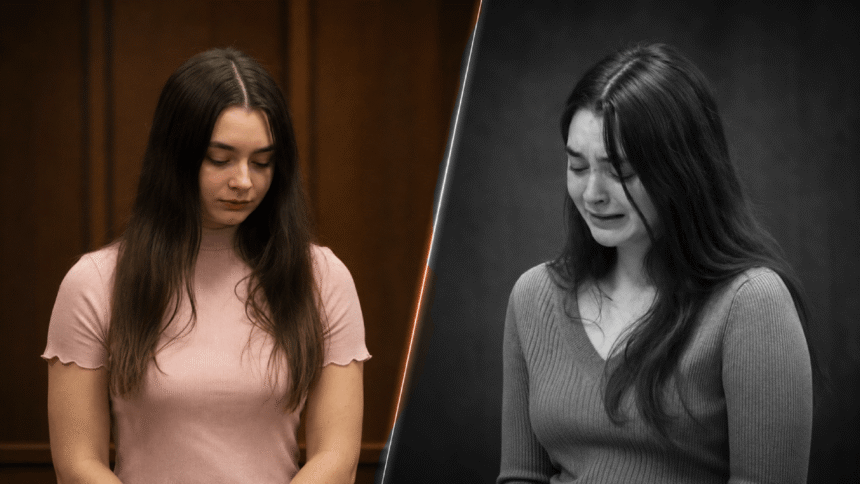
Mackenzie Shirilla is serving two concurrent sentences of 15 years to life for the murders of Dominic Russo and Davion Flanagan, who died when she drove into a brick building in Strongsville, Ohio, in July 2022.
Shirilla was 17 at the time of the crash. Following a bench trial in 2023, a judge found that she had accelerated deliberately, maintained a direct route toward the building and made no meaningful attempt to brake or avoid the collision.
Her state conviction remains in effect. The Supreme Court of Ohio declined another request to review her post-conviction case in June 2026. Her attorneys then filed a federal habeas corpus petition in July, arguing that constitutional errors and ineffective legal representation deprived her of a fair trial.
As of August 2026, the federal petition is pending. It has not overturned her conviction or produced a new trial.
What Happened in Strongsville?
The crash occurred during the early morning of July 31, 2022, in an industrial area of Strongsville, a suburb of Cleveland.
Shirilla was driving a Toyota Camry. Dominic Russo, her 20-year-old boyfriend, and their 19-year-old friend Davion Flanagan were passengers.
The vehicle traveled at close to 100 miles per hour before striking a brick building. Russo and Flanagan died at the scene. Shirilla survived but suffered serious injuries and required hospital treatment.
Investigators initially had to determine whether the collision was an accident, reckless driving or an intentional act. The physical evidence eventually led prosecutors toward the third conclusion.
The distinction was legally crucial. Extreme speed can support vehicular-homicide charges, but a murder conviction requires proof that goes beyond ordinary negligence. Prosecutors needed to show that Shirilla knowingly caused the deaths rather than simply losing control.
The Evidence Presented at Trial
The prosecution’s case relied heavily on surveillance footage and information recovered from the vehicle.
Data showed that the car accelerated rapidly before impact. Prosecutors argued that its direction remained controlled and that Shirilla did not apply the brakes or steer away from the building.
The road was not presented as a sharp curve that could have surprised an inexperienced driver. The vehicle traveled along what the trial court concluded was a deliberate route toward a fixed object.
Prosecutors also introduced evidence concerning the troubled relationship between Shirilla and Russo, including prior arguments and statements they believed demonstrated intent. The defense disputed the prosecution’s interpretation and argued that the evidence did not prove she intended to kill anyone.
Shirilla waived a jury trial, leaving Cuyahoga County Common Pleas Court Judge Nancy Margaret Russo—not related to Dominic Russo—to decide the case.
The judge concluded that the collision was intentional rather than an instance of reckless driving. Shirilla was convicted in August 2023 of multiple counts including murder, felonious assault, aggravated vehicular homicide, drug possession and possession of criminal tools.
Remembering Dominic Russo and Davion Flanagan
Public coverage frequently centers Shirilla because she was the defendant, survived the crash and continues to pursue appeals. That focus can push Russo and Flanagan to the margins of their own story.
Dominic Russo was 20. Davion Flanagan was 19. They were not supporting figures in a spectacle about a teenage defendant; they were two young men whose lives ended before either had the opportunity to enter adulthood fully.
Their families delivered statements during sentencing about grief, lost futures and the permanent absence created by the crash.
Davion’s family has also objected to coverage that treats him merely as “the friend” traveling with the couple. He was an individual victim, not incidental damage in a conflict involving Shirilla and Russo.
Responsible reporting should name both men and avoid presenting the case as a romance that ended tragically. The court found that two separate murders occurred.
Why the Sentence Is 15 Years to Life
In August 2023, Shirilla received two life sentences with parole eligibility after 15 years. The terms run concurrently rather than consecutively.
Concurrent sentences are served at the same time. Shirilla therefore does not have to complete one minimum term and then begin another. She becomes eligible for parole after serving the required minimum period, subject to the official calculation of her sentence.
Eligibility does not guarantee release. A parole board will consider the convictions, institutional record, evidence of rehabilitation, statements from the victims’ families and other statutory factors.
Ohio prison records have listed her first expected parole consideration in 2037. The exact administrative date can change, so it is more accurate to describe her as eligible for consideration after the minimum term than to say she will be released that year.
The court also permanently suspended her driving privileges.
Where Is Mackenzie Shirilla Now?
Shirilla is incarcerated at the Ohio Reformatory for Women in Marysville.
She has continued challenging her convictions through both direct and post-conviction proceedings. Some online summaries incorrectly describe every filing as the same appeal, but several legally distinct processes have occurred.
That difference explains why one court ruling may address the trial evidence while another focuses only on a filing deadline.
Her Direct Appeal Was Unsuccessful
After sentencing, Shirilla appealed her convictions to Ohio’s Eighth District Court of Appeals.
Her attorneys challenged the sufficiency and weight of the evidence, arguing that the prosecution had not proved the required intent. They also raised issues involving the charges and trial proceedings.
In September 2024, the appeals court affirmed the convictions. Its published opinion concluded that sufficient evidence supported the trial court’s findings and rejected the arguments for reversal.
This was the direct appeal—the ordinary process in which a higher court reviews claimed errors reflected in the trial record. The Supreme Court of Ohio later declined to accept further review of that case.
The result left the murder convictions and sentence intact.
The One-Day-Late Petition Was a Different Legal Challenge
A separate controversy involved Shirilla’s petition for post-conviction relief.
Post-conviction proceedings allow defendants to raise certain constitutional claims or rely on material outside the original trial record. Shirilla’s later lawyers argued, among other things, that her trial representation had been ineffective and that medical evidence should have been investigated.
Ohio law imposed a deadline tied to the filing of the trial transcript in the direct appeal. Shirilla’s petition was submitted one day after the court found that deadline had expired.
Her attorneys said the mistake resulted from failing to account correctly for 2024 being a leap year. They also argued that a later-filed transcript should have changed the date on which the filing period began.
The trial court dismissed the petition as untimely. In March 2026, the Eighth District Court of Appeals upheld that ruling, finding that the lower court lacked jurisdiction to consider the late filing under the applicable statute.
The Supreme Court of Ohio declined jurisdiction in June 2026.
This ruling is often simplified online as “the court rejected her medical evidence.” That is not quite what happened. The state courts primarily determined that the post-conviction petition was filed too late and that the statutory exceptions did not permit review. They did not conduct a full evidentiary trial on every new factual claim contained in the petition.
That procedural distinction does not prove those claims are correct. It explains why the courts did not reach their merits.
What Medical Condition Does the Defense Cite?
Shirilla’s current lawyers have cited postural orthostatic tachycardia syndrome, commonly known as POTS, as a condition that might have caused a loss of consciousness.
POTS affects the body’s regulation of heart rate and circulation when a person changes position. Symptoms can include dizziness, rapid heartbeat, weakness and fainting.
The defense argument is not merely that Shirilla had a medical diagnosis. Her attorneys contend that her original lawyers should have investigated whether a medical event could explain the crash and should have obtained appropriate expert testimony.
A diagnosis by itself would not establish that she lost consciousness while driving. A court would need to evaluate medical history, symptoms near the time of the collision, vehicle behavior and expert opinions about whether the proposed explanation fits the evidence.
Prosecutors have maintained that the surveillance footage and vehicle data demonstrate controlled acceleration and intentional conduct.
The Federal Habeas Corpus Petition
After the state post-conviction proceedings failed, Shirilla’s attorneys filed a federal petition for a writ of habeas corpus in July 2026.
A federal habeas petition does not function as another ordinary appeal. Federal courts generally do not retry the facts simply because a defendant disagrees with a state judge.
Instead, the petitioner must identify a violation of federal constitutional rights and overcome strict rules governing deadlines, prior state-court review and procedural default.
Shirilla’s petition reportedly argues that her trial counsel was constitutionally ineffective. It cites the failure to investigate or present medical evidence and other material that her current lawyers believe could have changed the verdict.
The petition also challenges aspects of the evidence and trial process. The state will have an opportunity to respond before the federal court decides whether any claim warrants further proceedings.
Filing the petition does not suspend her sentence. She remains incarcerated while the case proceeds.
Why Ineffective-Assistance Claims Are Difficult
To overturn a conviction for ineffective assistance of counsel, a defendant generally must establish two points.
First, the lawyer’s performance must have fallen below an objective standard of reasonable professional representation. Courts give attorneys considerable discretion when assessing strategic decisions made during a trial.
Second, the defendant must show prejudice—a reasonable probability that the outcome would have been different without the deficient performance.
It is not enough to demonstrate that another lawyer would have approached the case differently. The omitted evidence must be sufficiently important to undermine confidence in the verdict.
In Shirilla’s case, a federal court would also need to address procedural questions created by the missed state post-conviction deadline. Federal habeas rules often limit review of claims that were not properly presented through available state procedures.
The federal petition is therefore a significant legal step, but it should not be described as proof that a new trial is imminent.
What the Documentary Changed
Renewed interest in the case followed the 2026 release of the Netflix documentary The Crash.
True-crime documentaries often introduce trial evidence to audiences who did not follow the original proceedings. They can also encourage viewers to treat a closed record as an interactive mystery, with social-media users selecting fragments that support a preferred conclusion.
A documentary is not an appellate court. It may include interviews, editing choices and material unavailable during the trial, but it does not issue a legally binding judgment.
The most reliable method for understanding the case is to separate four categories:
- Evidence admitted and tested at trial
- Findings made by the trial judge
- Arguments raised later by the defense
- Claims circulating through documentaries or social media
Those categories can overlap, but they are not interchangeable.
The public may debate whether the defense should have pursued a different medical theory. The existing legal fact remains that Shirilla was convicted after a bench trial, her direct appeal failed and no later court has vacated that judgment.
Social Media Is Not Evidence of Guilt or Innocence by Itself
Shirilla’s online activity before and after the crash received substantial attention. Videos, photographs and comments were interpreted as evidence about her personality and level of remorse.
Such material can be relevant when it contains a threat, admission or fact directly connected to the alleged offense. It becomes less reliable when viewers try to infer guilt from facial expressions, clothing, music choices or how a person behaves in a short clip.
Grief, shock, trauma and self-presentation do not have a universal appearance. A defendant should not be convicted because internet users dislike the way she looks in a video.
In this case, the court’s decision rested on a broader evidentiary record that included the vehicle’s movement, crash data, surveillance footage and evidence concerning intent. The legal case should not be reduced to whether Shirilla appeared emotional enough online.
The same caution applies to claims made by former inmates, anonymous sources or accounts seeking attention from the documentary’s popularity. Unless tested in court or independently verified, they remain allegations.
The Current Status of the Case
As of August 2026:
- Shirilla remains convicted of murdering Dominic Russo and Davion Flanagan.
- She is serving concurrent sentences of 15 years to life.
- Her direct appeal was denied and the convictions were affirmed.
- Her state post-conviction petition was dismissed as untimely.
- The Supreme Court of Ohio declined to review the latest state appeal in June 2026.
- Her attorneys filed a federal habeas corpus petition in July 2026.
- The federal petition has not yet resulted in a new trial or overturned conviction.
- Her first parole consideration is expected in 2037.
The Cuyahoga County Prosecutor’s Office sentencing statement summarizes the convictions and sentence. The Eighth District’s published direct-appeal decision provides the fuller legal record behind the affirmed judgment.
The next meaningful development will come from the federal court handling Shirilla’s habeas petition. Until that court rules, descriptions claiming that she has won a new appeal—or exhausted every possible legal option—go beyond the current record.
For Russo’s and Flanagan’s families, however, the legal distinctions do not alter the central loss. Two young men died in Strongsville, and every new wave of attention should begin with their names rather than the notoriety of the person convicted of killing them.
For latest uptades keep it in touch with us at Voyagemagazine.