


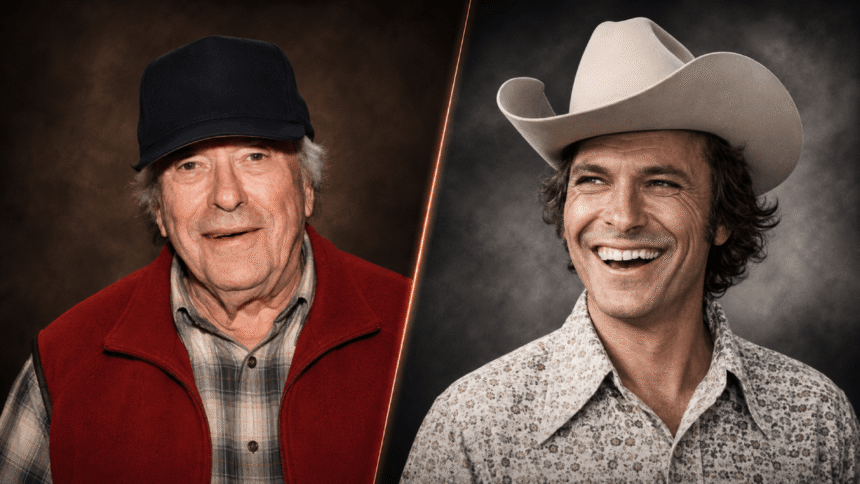
Rip Torn spent much of his career playing men who were supposed to represent order but appeared capable of destroying it.
As Artie on The Larry Sanders Show, he was a television producer protecting his star through intimidation, profanity and shameless manipulation. In Men in Black, he ran a secret government organization from beneath New York City. In Dodgeball, he transformed sports coaching into a campaign of flying tools and verbal abuse.
The settings changed, but the dramatic function remained remarkably consistent. Torn understood institutions—Hollywood, government, the military and organized sport—as places where personality could matter more than the official rules.
That perspective came from an actor whose own life repeatedly resisted tidy categories. He was a Texas agricultural student who moved into New York theater, a serious dramatic performer who became a comedy icon in his sixties, and an admired craftsman whose volatility sometimes caused real harm.
Rip Torn Was His Real Name—Almost
Torn was born Elmore Rual Torn Jr. in Temple, Texas, on February 6, 1931. “Rip” was not a Hollywood invention. It was a family nickname also used by his father and uncle.
Fellow acting students later encouraged him to adopt a more conventional stage name, assuming audiences would never take “Rip Torn” seriously. He refused.
The decision now seems inevitable. Few names have ever matched a performer so well. It sounds like a physical command, an injury and a character description compressed into two syllables.
Yet the name also contributed to a public mythology that sometimes overwhelmed the disciplined actor behind it. Torn was not simply a naturally eccentric presence dropped in front of a camera. He studied, trained and worked extensively in theater before popular culture embraced him as a professional wild man.
From Temple to the New York Stage
Torn attended Texas A&M University before transferring to the University of Texas, where he studied acting. He later served in the United States Army as a military police officer during the Korean War era.
After his military service, he pursued acting in Hollywood but found only minor opportunities. He supported himself with jobs including washing dishes and cooking before moving to New York for more serious training.
There, Torn studied at the Actors Studio during a period when method acting was reshaping American performance. The emphasis on psychological truth and emotional access suited him. Torn did not appear interested in making a character agreeable; he wanted the character’s impulses to feel immediate.
His Broadway breakthrough came in Tennessee Williams’s Sweet Bird of Youth. Torn played Tom Finley Jr. in the original 1959 production, appearing alongside Paul Newman and Geraldine Page. He received a Tony Award nomination and later repeated the role in the 1962 film adaptation.
The journey from central Texas to Broadway was more than a change of address. Torn entered a theatrical culture that treated emotional danger as artistic material. His performances retained both environments: the directness of a Texan who distrusted pretense and the intensity of an actor trained to search beneath it.
The Serious Actor Behind the Comedy
Viewers who know Torn through Dodgeball or Men in Black may be surprised by the weight of his early dramatic career.
He appeared in films such as A Face in the Crowd, King of Kings, The Cincinnati Kid and The Man Who Fell to Earth. His characters were often unstable, antagonistic or difficult to read, but Torn avoided presenting menace as a simple fixed quality.
In Nicolas Roeg’s The Man Who Fell to Earth, he played Nathan Bryce, a scientist whose curiosity brings him into the orbit of David Bowie’s alien visitor. Bryce is intelligent enough to recognize that something extraordinary is happening but morally uncertain about what to do with that knowledge.
The film moves through an America of laboratories, corporate interiors, anonymous roads and desert landscapes. Torn’s presence helps connect its speculative ideas to human appetite. Scientific discovery does not occur outside ordinary weaknesses; it becomes another opportunity for ambition and betrayal.
In Cross Creek, Torn played Marsh Turner, a rural Florida resident and friend of author Marjorie Kinnan Rawlings. The performance earned him an Academy Award nomination for Best Supporting Actor.
The role demonstrated a gentler side without sanding away his roughness. Torn could suggest a life shaped by place—its labor, poverty, pride and isolation—without turning the character into regional decoration.
The Easy Rider Story and the Cost of a Reputation
Torn was originally considered for the role in Easy Rider that eventually went to Jack Nicholson. For years, a story circulated that he lost the part after threatening Dennis Hopper with a knife during an argument.
Torn disputed that account. When Hopper repeated it on The Tonight Show in 1994, Torn sued him for defamation. He maintained that Hopper had produced the knife, not him. A court found in Torn’s favor and awarded damages.
The case matters because it shows how a performer’s image can rewrite disputed events. Audiences already believed Torn was volatile, so Hopper’s version sounded plausible. A story that matched the persona traveled more easily than the actor’s denial.
It also demonstrates the danger of treating Hollywood anecdotes as verified history. Entertaining stories accumulate authority through repetition, particularly when everyone involved has a famous name. The lawsuit established that repetition was not evidence.
Torn’s reputation was not entirely invented, however. Other incidents supplied genuine reasons for colleagues and audiences to regard him as unpredictable.
The Maidstone Fight Was Real
The most notorious example occurred during the production of Norman Mailer’s largely improvised film Maidstone.
Torn played the half-brother of Mailer’s character. During filming, he struck Mailer on the head with a hammer and attempted to choke him. Mailer responded by biting Torn’s ear. The physical confrontation was captured by the cameras and included in the completed film.
The scene is disturbing because it collapses the distance between acting and assault. Whatever creative framework surrounded the improvisation, both men were genuinely injured.
It is sometimes celebrated as evidence of a fearless period in independent filmmaking. A more useful interpretation is that artistic spontaneity does not eliminate responsibility. The presence of a camera can document reckless behavior; it does not justify it.
Torn’s best performances draw power from emotional danger held inside a controlled form. The Maidstone fight shows what happens when that control fails.
Artie Was the Role Rip Torn Had Been Waiting For
Torn’s defining late-career role came in 1992 with HBO’s The Larry Sanders Show. He played Arthur, known as Artie, the veteran producer of a fictional late-night talk show hosted by Garry Shandling.
Artie is loyal, ruthless, sentimental and ethically flexible. He treats show business as both a sacred calling and organized combat. His job is to protect Larry’s confidence, manage network executives, manipulate guests and keep the production functioning regardless of the human cost.
Torn’s performance won an Emmy in 1996 after he received a nomination for each of the show’s six seasons.
The brilliance of Artie lies in the way Torn combines authority with appetite. He does not play the producer as a detached corporate strategist. Artie loves television with the intensity of someone defending the last honest trade in America, even while lying constantly to everyone around him.
This is where Torn’s Texas background, theatrical training and combustible image converge. Artie sounds like an old-school operator who has spent decades learning which doors matter and which rules can be ignored.
The studio in The Larry Sanders Show becomes a complete social world. Corridors, offices, dressing rooms and the space behind the curtain carry different levels of power. Artie moves through all of them. He is less a resident than the building’s nervous system.
The series influenced later workplace comedies including 30 Rock and Curb Your Enthusiasm. Torn eventually appeared on 30 Rock as Don Geiss, the head of the fictional General Electric–like corporation that owns NBC. Again, he played institutional power as something personal, eccentric and faintly feudal.
Zed Made Bureaucracy Funny in Men in Black
In the 1997 science-fiction comedy Men in Black, Torn played Chief Zed, the head of an organization that monitors extraterrestrial life on Earth.
The film’s New York exists on two levels. The visible city contains commuters, taxis, restaurants and pawnshops. Beneath it operates an immigration bureaucracy for aliens, complete with forms, security procedures and office politics.
Zed makes that absurd premise credible. Torn plays him as a weary administrator who has already seen every possible cosmic emergency and remains more irritated than amazed.
His performance is restrained compared with Artie or Patches O’Houlihan. Zed rarely needs to raise his voice because the entire organization recognizes his authority. Torn’s face and timing do the work.
The casting also creates an effective joke about government institutions. Even an agency dealing with interstellar visitors is ultimately run by a gruff older man behind a desk.
Zed fits Torn’s career-long interest in unstable authority, but this time the character is genuinely competent. He understands the secret world and knows how to guide Will Smith’s Agent J into it.
Patches O’Houlihan and the Logic of Dodgeball
Torn reached another generation as Patches O’Houlihan in the 2004 comedy Dodgeball: A True Underdog Story.
Patches is a legendary former player who agrees to coach the struggling Average Joe’s team. His methods include throwing metal tools at trainees on the theory that anyone capable of avoiding a wrench can avoid a ball.
The humor depends on Torn’s absolute commitment. He does not signal that Patches’s advice is ridiculous. He delivers each principle as if it has been tested over decades and preserved through sacred tradition.
A less forceful actor might have turned the character into a brief collection of jokes. Torn gives Patches a complete worldview. Pain is preparation, hesitation is weakness and victory belongs to the person willing to accept the most unreasonable training.
The role parodies the hard-driving sports mentor, but it also captures Torn’s unusual comic gift. He could make nonsense sound like institutional wisdom.
A Career Connected by Unruly Authority
Torn’s characters appear to be wildly different: a Tennessee bully, a scientist, a Florida local, a television producer, a secret agent, a network chairman and a dodgeball coach.
The connecting idea is authority under pressure.
Sometimes Torn played the rebel confronting an institution. Later, he became particularly effective at playing the institution itself. His older characters occupied the executive office, control room or training court, but they brought the same emotional unpredictability he had once used as an outsider.
That shift is the non-obvious key to his career. Torn did not abandon his wildness when he moved into comedy. He placed it behind a desk and gave it administrative power.
Artie is funny because no employee handbook can contain him. Zed is convincing because he seems stranger than some of the aliens. Patches is memorable because he treats a marginal sport like a military order.
Torn made bureaucracy feel human by making it unreasonable.
The Later Legal Troubles
Any honest account of Torn’s life must separate his artistic achievements from conduct that caused concern.
He experienced several alcohol-related arrests. In 2010, he entered a closed bank in Connecticut while carrying a loaded firearm. Police said he was intoxicated and apparently believed the building was his home.
Torn later pleaded guilty to charges including reckless endangerment, criminal trespass and carrying a firearm while intoxicated. He received a suspended prison sentence and probation.
The incident is sometimes folded into the mythology of Rip Torn as an eccentric character. That framing is too comfortable. Entering a building with a loaded weapon while intoxicated created genuine danger.
His volatility contributed to his work, but talent does not transform harmful behavior into charming folklore. Torn himself acknowledged that anger and strong emotion were part of his makeup. The same intensity that gave him access to powerful performances did not excuse the occasions when he failed to manage it.
The Family and Career Behind the Public Persona
Torn was married three times. His first marriage was to actress Ann Wedgeworth. He later married Geraldine Page, his Sweet Bird of Youth co-star and one of the most respected American stage actors of her generation. They remained married until her death in 1987.
His third wife was actress Amy Wright. Torn had six children across his marriages, several of whom pursued creative careers.
He also helped his cousin Sissy Spacek when she began establishing herself as an actor in New York. The connection is a reminder that Torn’s legacy extends beyond his own screen appearances into a wider Texas acting lineage.
Torn died at his home in Lakeville, Connecticut, on July 9, 2019. He was 88. His career had lasted more than six decades across theater, film and television.
The PBS NewsHour account of his life and career captures the scale of that journey: from dark dramatic roles to an Emmy-winning reinvention in comedy.
Why Rip Torn Remains Impossible to Replace
Character actors often make fictional places convincing by appearing to have lived there before the story began. Torn went further. He made every institution look as though it had acquired its own dangerous personality.
In The Larry Sanders Show, Hollywood becomes Artie: loyal, vain, manipulative and unable to survive without constant performance. In Men in Black, secret government feels like Zed: exhausted, competent and accustomed to absurdity. In Dodgeball, organized sport becomes Patches: cruel, irrational and somehow inspirational.
Torn brought Texas directness into New York theater, method intensity into Hollywood supporting roles and dramatic danger into comedy. He could make a room funnier simply by treating its ridiculous rules with complete seriousness.
His life should not be romanticized into a harmless wild-man legend. It contained professional conflict, alcohol problems and episodes of alarming behavior. But neither should those events obscure an actor of unusual discipline, intelligence and range.
Rip Torn’s greatest characters understood that authority is partly theater. The uniform, desk or title matters—but only until someone with a stronger personality walks into the room.
For more interesting one Read like on Read like on Wilford Brimley Yellowstone: The Tribute That Still Confuses Viewers.