


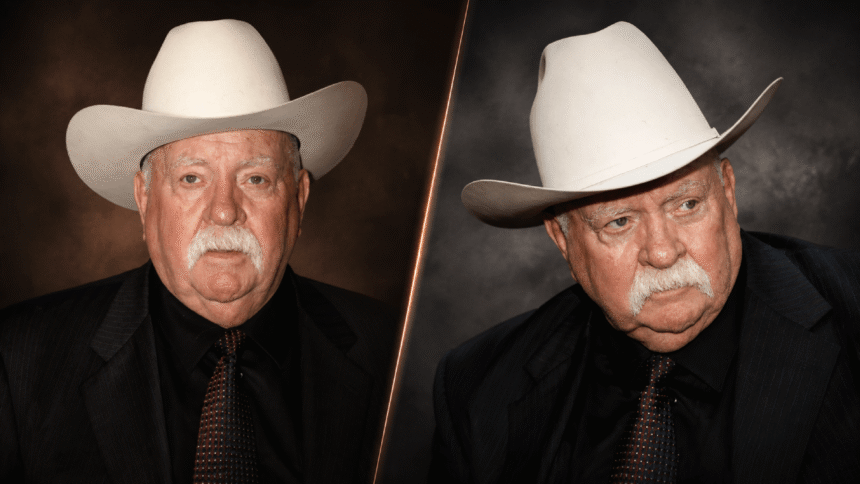
Wilford Brimley never appeared in Yellowstone. He did not play a Dutton relative, ranch hand or neighboring landowner, despite having the voice, mustache and real-world cowboy experience to fit naturally into the series.
His connection to the show comes from a memorial card at the end of Season 3, Episode 9, “Meaner Than Evil.” It read:
In loving memory of Wilford Brimley.
A cowboy, an artist, and a damn good friend.”
The episode aired in August 2020, shortly after Brimley died at the age of 85. The tribute was not acknowledging a forgotten guest appearance. It was honoring a performer whose life and work represented the kind of Western authenticity Yellowstone has consistently tried to place on screen.
Was Wilford Brimley in Yellowstone?
No. Brimley has no acting credit in the series and did not appear in any episode.
The confusion is understandable. Yellowstone regularly casts veteran Western performers, working cowboys, horse trainers and ranching figures alongside its principal actors. Brimley’s appearance and screen persona seem so compatible with Taylor Sheridan’s fictional Montana that some viewers remember him as part of it.
The memorial card creates another layer of uncertainty. Television productions usually reserve end-of-episode tributes for cast members, crew members or consultants who worked directly on the program. Viewers who saw Brimley’s name therefore assumed they had overlooked his character.
In this case, the title card served a broader purpose. It recognized a man who embodied the Western tradition on which the series draws, even though he never entered the Dutton ranch on screen.
Which Episode Included the Tribute?
The dedication appeared at the end of “Meaner Than Evil,” the ninth episode of Yellowstone Season 3.
The episode originally aired on August 16, 2020, approximately two weeks after Brimley’s death on August 1. It was the penultimate installment of a season dominated by conflict over land, loyalty and the future of the Yellowstone ranch.
The wording of the card is revealing. It does not call Brimley a star or list his best-known films. Instead, it identifies him first as “a cowboy,” then as “an artist” and finally as “a damn good friend.”
That order reflects how Brimley spoke about himself. Acting came relatively late in a life already shaped by horses, ranch work, military service and manual trades. Hollywood did not manufacture his Western identity; it eventually found a use for experience he already possessed.
The Actor Viewers May Be Mistaking for Brimley
Some viewers associate Brimley with a scene that takes place at the Four Sixes Ranch during Season 4. Jimmy Hurdstrom meets an older cowboy named Ross, who offers direct advice about becoming a useful hand.
Ross was played by Barry Corbin, not Wilford Brimley.
The resemblance is more cultural than exact. Both men built careers playing weathered authority figures, ranchers and Western characters who communicated experience without elaborate speeches. Each could make a line sound as though it came from decades of hard work rather than a screenplay.
Corbin appeared in Yellowstone after Brimley’s death, which rules out the possibility that the scene featured Brimley. Still, the mistake says something interesting about both performers. They belong to a recognizable school of American character acting in which credibility comes from posture, voice and an apparent familiarity with the land.
Brimley Was a Cowboy Before He Was an Actor
Anthony Wilford Brimley was born in Salt Lake City, Utah, in 1934. He left school as a teenager and later served in the United States Marine Corps.
Before becoming a professional actor, Brimley worked in a range of practical jobs. He rode horses, worked on ranches, trained animals, shod horses as a farrier and spent time as a blacksmith. He was also employed as a bodyguard for businessman Howard Hughes.
His route into film and television began through horses. Brimley found work shoeing animals used in Western productions and then moved into riding, stunt work and background appearances.
This history gave him something difficult for a production to manufacture. He did not need to be taught how a working cowboy occupied space. Saddles, reins, boots and ranch tools did not look like props in his hands.
Brimley’s authenticity was not based on romantic distance from the West. It came from labor. He understood that horses require daily care, that equipment has a practical purpose and that ranch work continues when nobody is watching.
That distinction is central to Yellowstone. The series frequently presents ranching as a combination of inherited identity, skilled employment and physical obligation. Its characters may deliver speeches about land and legacy, but the world becomes convincing through smaller details: repairing fences, moving cattle, doctoring animals and waking before daylight.
Brimley belonged to the tradition behind those details.
From Horse Sets to Speaking Roles
Brimley worked around productions such as Gunsmoke and Bonanza before securing more substantial acting parts. He appeared on The Waltons as Horace Brimley and gradually developed a screen identity built around plain speech and practical authority.
His breakthrough film role came in The China Syndrome in 1979. Brimley played Ted Spindler, an engineer caught inside a nuclear-power controversy. The setting was far removed from a cattle ranch, but the performance used qualities that would define his career.
Spindler appears to be an ordinary working man rather than a polished executive or conventional hero. When he finally speaks under pressure, Brimley makes technical and moral conviction feel inseparable. The character understands the machinery, which gives his judgment greater weight than the reassurances offered by management.
That dynamic appeared repeatedly in Brimley’s work. He often played the person who knew how the system functioned because he had spent years inside it. His authority came from competence rather than status.
The Western Films Behind the Yellowstone Connection
Brimley’s filmography includes numerous Westerns and modern stories shaped by cowboy culture.
He worked as a rider and extra during the earlier phase of his career, including uncredited appearances associated with major Western productions. As his profile grew, he took more prominent roles in films and television projects such as The Electric Horseman, Gore Vidal’s Billy the Kid, Blood River, The Good Old Boys and Crossfire Trail.
In The Electric Horseman, Robert Redford plays a former rodeo champion who rebels after discovering that a valuable horse is being mistreated for corporate promotion. The film’s conflict between commercial spectacle and responsibility to an animal fits naturally with Brimley’s background as a horseman.
The Good Old Boys, directed by Tommy Lee Jones, examines an aging cowboy confronted by a West changing around him. Its landscapes are not presented as an untouched fantasy. They are workplaces and contested homes, shaped by economic pressure and generational change.
Crossfire Trail, adapted from a Louis L’Amour novel, places Brimley within a more traditional ranch-centered Western. He plays Joe Gill, an ally in a story involving a promise to protect a dead man’s ranch and widow.
These projects helped establish the screen vocabulary that Yellowstone later modernized: property under threat, loyalty expressed through action and characters whose identities are inseparable from the land.
Why Yellowstone Honors Real Western Experience
Taylor Sheridan’s productions regularly blur the boundary between Western drama and working cowboy culture.
Actors including Forrie J. Smith entered the profession with substantial rodeo or ranching experience. Horse trainers and competitors have appeared as themselves or in small roles. The series has also featured respected figures such as cutting-horse trainer Buster Welch and bit-and-spur maker Billy Klapper.
These appearances do more than create publicity. They establish a chain of authenticity. A fictional ranch feels more credible when some of the people inside it move, speak and work with knowledge acquired outside the production.
The Brimley title card belongs to that same philosophy. He did not contribute to Yellowstone through a documented character, but his career demonstrated how lived experience can deepen screen performance.
The show was paying respect to a predecessor: someone who helped make the working West legible to audiences without sanding away all its roughness.
Brimley’s Best-Known Roles Went Beyond the West
Although the Yellowstone tribute emphasized Brimley’s cowboy identity, many viewers know him from films with no direct connection to ranching.
In John Carpenter’s The Thing, he played Dr. Blair, a biologist at an Antarctic research station invaded by an organism capable of imitating other life forms. Brimley turns scientific realization into quiet terror. Blair understands the scale of the threat before most of the group, but his response makes him appear unstable.
The film uses the Antarctic setting as more than a visual attraction. Isolation removes any easy escape, while the weather transforms distance into a weapon. Brimley’s practical screen presence makes the supernatural crisis feel like a workplace disaster being recognized by the one man capable of reading the evidence.
In Cocoon, he played Ben Luckett, one of a group of retirement-home residents rejuvenated after swimming in a pool charged by alien technology. Brimley was only in his late forties when the film was made, considerably younger than his character and some of his co-stars.
His prematurely weathered appearance helped him play older men, but his performance is not a caricature of age. Ben’s renewed energy creates hope, guilt and an impossible decision between adventure and the people he loves.
Brimley also appeared in The Natural, Tender Mercies, Absence of Malice, The Firm and In & Out. Across genres, he specialized in men who seemed rooted in a moral or practical code—even when the character turned out to be dangerous.
The Commercials and the Internet Persona
For another generation, Brimley became recognizable through Quaker Oats advertisements and Liberty Medical commercials about diabetes supplies.
His direct pronunciation of “diabetes” became widely imitated online, turning him into an internet meme years after the commercials first aired. The jokes sometimes overshadowed the fact that Brimley lived with diabetes and advocated for testing, treatment and practical management of the condition.
The advertisements relied on the same qualities as his dramatic roles. Brimley appeared trustworthy because he sounded unimpressed by marketing language. He delivered information with the manner of a neighbor who expected the listener to use common sense.
That public image—plain-spoken, mustached and mildly impatient—makes it even easier to imagine him confronting a problem at the Dutton ranch.
A Western Identity Built on Work, Not Costume
Brimley died in a hospital in St. George, Utah, after experiencing several health problems and undergoing dialysis. His death returned attention to the unusual path that had taken him from ranches and horse sets to some of the most enduring films of the late 20th century.
The Washington Post obituary described him as both a Utah blacksmith and horse trainer before discussing the acting career that made him famous. That sequence matters.
Brimley’s persona was persuasive because it had not been invented solely for the camera. When he played a rancher, engineer, sheriff or retired seaman, he projected the confidence of someone accustomed to solving concrete problems.
Modern Western productions spend considerable time and money recreating that quality. They hire consultants, train actors to ride and search for landscapes that have not been visually overwhelmed by contemporary development. Brimley carried much of it with him.
Why the Tribute Fits Yellowstone
The connection between Wilford Brimley and Yellowstone is ultimately about inheritance.
The series inherited a genre shaped by performers who knew the practical West as well as its mythology. Brimley was one of them. He could play a cowboy without presenting cowboy life as fancy dress, and he could bring the same grounded credibility to a nuclear plant, an Antarctic station or a Florida retirement home.
His memorial card also expressed something Yellowstone repeatedly argues: belonging is not measured only by paperwork or an official title. It can come from shared values, work and memory.
Brimley never rode onto the Yellowstone Dutton Ranch. He did not need to. The series recognized that part of its world had already been built by actors like him—the people who made Western landscapes feel inhabited before the Dutton family ever appeared on television.
For more interesting one Read like on Read like on Brion James: The Character Actor Who Made Movie Worlds Feel Dangerous.