


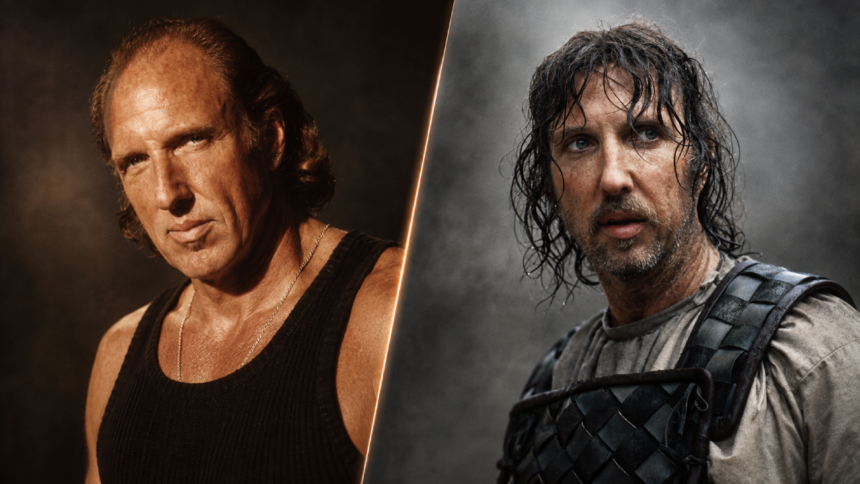
Brion James could change the atmosphere of a film simply by entering the frame. At 6 feet 3 inches, with a heavy build, an unmistakable voice and a talent for suggesting violence before it happened, he became one of Hollywood’s most recognizable character actors.
He is best remembered as Leon Kowalski, the replicant who opens Blade Runner with a quietly terrifying interrogation. Yet reducing James to one role—or even to the villains he played so frequently—misses what made him valuable.
James gave imaginary places a sense of danger. His presence helped turn a rain-soaked future Los Angeles, the Louisiana bayou, a corrupt police department or a chaotic 23rd-century New York into somewhere audiences could believe existed beyond the edges of the screen.
Growing Up Inside a California Cinema
Brion Howard James was born in Redlands, California, on February 20, 1945, and grew up in nearby Beaumont. His parents operated a local cinema, giving him an unusually direct childhood connection to film.
James later compared his early life to Cinema Paradiso. He spent his evenings around the theater, watching movies and helping to run them. For a boy in a relatively small Southern California community, the cinema provided a nightly passage into cities, frontiers and imagined worlds far beyond Beaumont.
Westerns made a particularly strong impression. James wanted to play cowboys and gangsters—the characters who brought danger and momentum into a story. That childhood ambition eventually became a remarkably accurate description of his career.
After studying theater arts at San Diego State College, James served in the United States Army. He and future actor Tim Thomerson worked as cooks in a tank unit before both pursued acting professionally.
James then moved to New York, where he studied with the influential acting teacher Stella Adler. Unable to afford conventional tuition, he reportedly worked for Adler as a cook and butler in exchange for lessons.
The arrangement belongs to an older, less polished version of the aspiring-actor story. There was no talent-show discovery or instant route to Los Angeles. James learned through theater, practical labor and years of minor roles.
New York Before Hollywood
In New York, James appeared in stage productions including Long Day’s Journey Into Night, Picnic and West Side Story. He also performed stand-up comedy at the Improv.
That theatrical and comic background is easy to overlook because his screen image became so closely associated with threatening men. Yet comedy helped shape the deliberate exaggeration in many of his performances. James understood when a villain needed to frighten the audience and when the character could become enjoyably larger than life.
He eventually returned to California and began collecting film and television credits during the 1970s. Early appearances included Gunsmoke, The Rockford Files, CHiPs, The Incredible Hulk and the landmark television miniseries Roots.
His feature work included Walter Hill’s Hard Times and The Driver. These projects helped establish the screen identity that would follow him: the intimidating stranger, criminal, enforcer or compromised authority figure whose arrival signaled that the safest part of the story had ended.
Typecasting restricted the parts James was offered, but it also made him exceptionally skilled within that territory. He did not play every heavy in the same way. Some were slow and dim, others calculating, bitter or absurd. Even his accents—occasionally eccentric and geographically difficult to place—gave individual characters their own internal logic.
Leon Kowalski Changed Everything
James’s defining role arrived in Ridley Scott’s Blade Runner in 1982. He played Leon Kowalski, one of a group of artificial humans who return illegally to Earth in an attempt to extend their limited lives.
Leon appears in the opening scene, undergoing a Voight-Kampff test designed to identify replicants through their emotional responses. The setting is controlled and bureaucratic: a bare room, a table, questions and an official procedure. James gradually turns it into a trap.
His performance works through contradiction. Leon appears physically powerful but mentally cornered. He struggles with the interviewer’s questions, yet the hesitation is not simple stupidity. He knows that discovery means death.
When the violence arrives, the film’s world changes. The test is no longer an abstract piece of science-fiction exposition. It becomes evidence that the boundary between human and machine is unstable—and that the city outside may contain people who are not what they seem.
James recognized how important the scene was. In a 1998 interview, he recalled that production spent three days filming it and observed that opening Blade Runner allowed him to establish the tone of the entire film. He also credited the role with transforming his career.
Leon is often described as a murderous replicant, but James gives him more emotional weight than that label suggests. He is frightened of dying, loyal to his companions and conscious of his limited intelligence. His brutality is real, but so is his vulnerability.
That combination helps explain why the performance has lasted. Leon is not merely an obstacle for Harrison Ford’s Deckard. He is one of the first signs that the supposed villains may have a stronger desire to live than the humans hunting them.
The Actor Who Established the Edge of Safety
James possessed a quality that could be called geographic menace. Directors frequently used him to mark the point at which a familiar environment became hostile.
In Walter Hill’s Southern Comfort, a group of Louisiana National Guardsmen becomes lost in the bayou after antagonizing local Cajuns. James plays one of the trappers, bringing a formidable physical presence to a landscape the soldiers cannot read.
The bayou is not simply a backdrop. It defeats conventional military confidence through mud, water, limited visibility and local knowledge. James looks as though he belongs to that environment, while the armed outsiders appear increasingly helpless within it.
In 48 Hrs., he appears on the other side of the law as Detective Ben Kehoe, one of the police officers working with Nick Nolte’s Jack Cates. The role is comparatively restrained, demonstrating that James could fit within a film’s professional world without becoming its central threat.
He returned for Another 48 Hrs., although the character’s function changed dramatically. James joked that it was his first sequel because he so rarely survived his films. The comment reveals how thoroughly his career depended on temporary but memorable disruption: arrive, destabilize the story and meet a violent end.
In Red Heat, Tango & Cash and numerous lower-budget action films, James continued to perform this function. His characters often belonged to the city’s hidden infrastructure—the smugglers, corrupt officers and hired muscle who understood how power moved after dark.
What His Unusual Accents Added
One of the pleasures of a Brion James performance is hearing what he does with language. His accents could be unexpected, particularly the Cockney-influenced voice he used as Requin in Tango & Cash.
Strict realism was not always the objective. James treated voice as part of a character’s silhouette. An unusual rhythm or pronunciation made a supporting villain distinguishable in a film already crowded with guns, threats and oversized personalities.
In less confident hands, this approach could become accidental comedy. James usually understood the tonal risk. He knew that action cinema often operates slightly above reality and that a villain may need to be remembered after only a few scenes.
His vocal choices also made his characters difficult to locate socially. They sounded as though they had traveled, crossed borders and survived in places the film’s heroes knew little about. Even when the geography was imprecise, the implied history made the character feel less generic.
The Player Proved He Could Do More
Robert Altman’s The Player offered James an important departure from physical heavies. He played studio executive Joel Levison, placing his imposing presence inside Hollywood’s corporate hierarchy.
The threat here is institutional rather than physical. In Altman’s version of Los Angeles, careers disappear through meetings, whispered decisions and shifting alliances. James does not need a weapon because the studio itself supplies the power.
He regarded the role as a turning point that allowed the industry to see him differently. Instead of appearing outside respectable society as a criminal or enforcer, he could play someone who controlled the room from within it.
The performance also exposes the arbitrary nature of typecasting. The same height, voice and stare that made James credible as a killer could make him equally convincing as an executive. Power changes costume more often than behavior.
For travelers fascinated by Hollywood, The Player remains a useful corrective to sightseeing mythology. Los Angeles may advertise itself through premieres, studio gates and celebrity homes, but the industry runs through offices where decisions are made without an audience. James looks entirely at home there.
A Friendlier Face in The Fifth Element
In Luc Besson’s The Fifth Element, James played General Munro, a comparatively sympathetic military officer in a wildly colorful vision of future New York.
The role allowed him to use his authority without automatically becoming the villain. Surrounded by flying traffic, vertical architecture, alien visitors and extravagant costumes, James provides a grounded institutional presence.
His performance also completed an intriguing science-fiction journey. In Blade Runner, he was an artificial man hunted by the state. In The Fifth Element, he represented the state while trying to prevent planetary destruction.
Both films imagine dense future cities, but they use James differently. Ridley Scott turns his size into evidence of a manufactured body built for labor and combat. Besson turns it into military authority. The actor remains physically imposing, yet the meaning of that physicality changes with the world around him.
James himself cited The Fifth Element when interviewers asked whether he ever played good men. The answer carried a trace of amusement: Hollywood had spent so long treating his appearance as proof of criminal intent that a decent general felt like a notable exception.
More Than 100 Films, Often Without Star Billing
By the time of his death, James had appeared in more than 100 films, as well as a vast range of television productions. His credits moved between major studio releases, independent pictures and genre films intended for the home-video market.
That volume was not unusual for a dependable character actor of his era, but it reveals a form of professional achievement that celebrity culture often ignores. James could enter an unfamiliar production, establish a character quickly and strengthen the world around the leads.
A film star is expected to draw attention toward the center. A character actor frequently performs the opposite task: making the surrounding environment feel populated by people with lives and motives beyond the hero’s immediate concern.
James understood that bargain. Asked about playing villains, he responded that bad guys were often the best parts. He also recognized the practical advantage of making the hero look more impressive. A convincing antagonist raises the stakes for everyone.
His willingness to move constantly between productions made his career, in his own description, a kind of gypsy existence lived out of a suitcase. The remark captures the hidden travel of film work: months in Santa Fe for a western, days on a studio set, then another city impersonating somewhere else.
The Man Behind the Menace
Accounts from colleagues describe a person very different from many of his screen characters. After James died, Corey Feldman remembered him as exceptionally kind and credited him with helping younger performers struggling with substance abuse.
James had reportedly faced addiction problems himself and used that experience to assist others. It is a significant part of his legacy because it complicates the easy association between performer and role.
Audiences repeatedly saw him as a source of danger. People who knew him described generosity, humor and care.
James died on August 7, 1999, after suffering a heart attack at his Malibu home. He was 54. The Los Angeles Times obituary recorded 103 motion-picture appearances, with several additional films released after his death.
Why Brion James Still Matters
James belonged to a class of actors whose names may be less familiar than their faces. Viewers encounter them across genres and decades, gradually recognizing that they have been essential to several favorite films.
His particular gift was making danger feel native to a place. Leon belongs to the industrial gloom of Blade Runner. The Cajun trapper belongs to the wet, disorienting landscape of Southern Comfort. Requin fits the exaggerated criminal Los Angeles of Tango & Cash. Joel Levison belongs to the polished predation of The Player.
These characters do not feel transported from a generic casting file. James adjusts his physicality, voice and degree of theatricality until he appears to have been waiting inside the film’s world before the hero arrived.
That is why revisiting his work offers more than nostalgia. Brion James demonstrates how a supporting actor can define the boundaries of an imagined place. He tells us where authority ends, where danger begins and what kind of person might thrive there.
The leading actors may guide us through those worlds, but James makes the worlds capable of fighting back.
For more interesting one Read like on Read like on Finn Wolfhard GF: Is the Stranger Things Star Dating Anyone?.